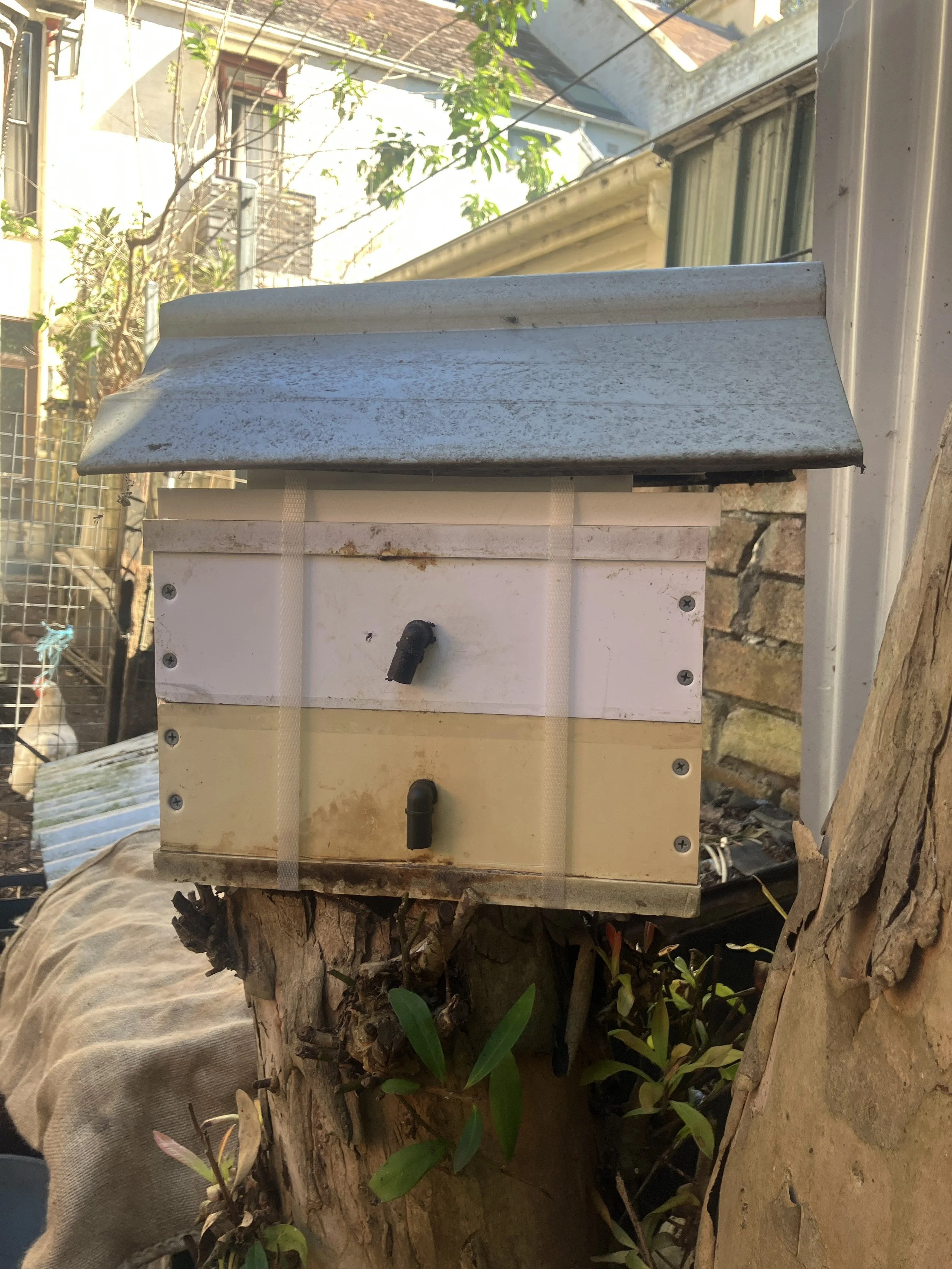
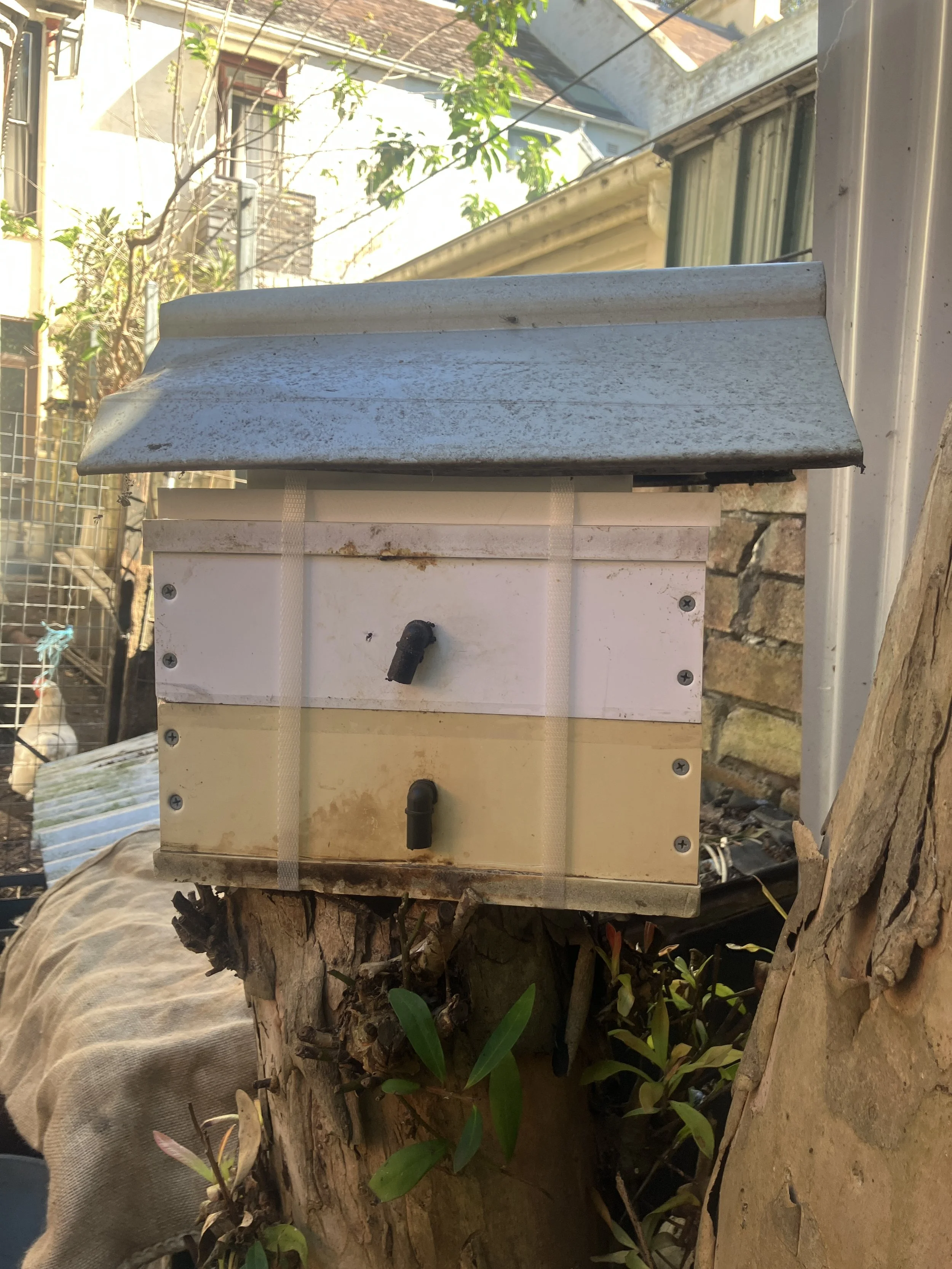
• Native bee hive in back garden of Sustainable House; designed and built by Sydney Stingless Bees
Key points:
This blog describes a project by an intern with Sustainable House, Jocelyn Seadler, and directed by Ros Gloag at Sydney University’s Bee Lab:
What flowers and plants do Australian native bees prefer?
· How we’re doing research to answer that question
· Project is a collaboration with Sydney University Bee Lab and Sustainable Projects
· Result to include a list of plants native bees forage from
Beginning in late August 2026 an intern working with Sustainable Projects, Jocelyn Seadler, and directed by Ros Gloag at Sydney University Bee Lab are researching the honey and resin sources for native bees in Chippendale, NSW, Australia. The project report is due in November 2026 and will include a plant list
Project summary
Survey of Native Bee honey and resin sources in Chippendale
By Jocelyn Seadler and Ros Gloag, 17 August 2026
Project Summary
The project identifies plants and forage preferred by the Australian native stingless bee, Tetragonula carbonaria, within a 300 m radius of two hives located in Myrtle Street, Chippendale, an inner city suburb beside Sydney’s central business district. The project commenced in August 2026 and is planned to complete by December 2026. The ideal temperature for bee foraging is 18 degrees and hotter. The project period begins in late winter and continues through Spring and Summer. Temperatures are expected to increase through the project. A project research report will be published in various media in December 2026. An intern with Sustainable Projects, Jocelyn Seadler, is carrying out field work and laboratory analysis of pollen and resins under the direction of Ros Gloag, Robinson Fellow, Sydney University Bee Lab.
Research methods:
· Draw a 300m radius around the two bee hives. This is mostly private property/housing aside from a bit of Victoria Park, so we can focus on surveying all public spaces and green strips in this area where the Sydney City Council and the public can plant.
· Survey on sunny days when the bees are likely to be out foraging.
· Collect pollen from all flowering plants and record species if possible; take a picture of each plant for later identification and reference (e.g. via iNaturalist).
· Collect pollen from bees entering the hive after foraging and compare it to surveyed plants using microscopy.
· Identify plants planted by the local council or by the Chippendale Footpath Garden community group under the council’s Footpath Garden Policy.
Sampling methods for pollen and resin:
· Collect pollen from bees entering the hive after foraging. The bee is captured by temporarily plugging the hive entrance and then trapping each returning forager in a separate vial. The vial is chilled on ice until the bee is immobile and the pollen balls on their legs are scraped off. The resulting pollen is then stained and visualized by microscope in the Sydney University BEE Lab, LEES Building F22, Camperdown Campus.
Research Questions:
· Are the flowering species currently being planted in public spaces by Sydney City Council and the Chippendale Footpath Garden Community native bee-friendly?
· Or are private gardens (with introduced species) providing most of the resources to these bees in urban areas?
Limitations:
· Some city-planted and community footpath garden planted species may be used by native bees but are not flowering at the commencement of the project, mid August.
· Data is from two hives in Myrtle Street; this may be enough to present an argument to the public, city council and other bodies involved in biodiversity but will not be academically conclusive.
· Pollen identification is restricted to plant families/groups for some plants, as their pollen shape/characteristics make them difficult to identify.
· High volume of flowering trees; very little flowering plants at ground level. It may be difficult to get samples from these trees if they are high up from the path.
Jocelyn Seadler, intern with Sustainable House, 17 August 2026
First progress report by Jocelyn Seadler, 1 September 2026
Jocelyn sent this brief report to those participating in the project:
“Hi Ros [Project Director, Sydney Uni Bee lab], IndigiGrow [supplied native plants to attract bees], Wormticklers [supplied native plants to attract bees], Bruce [local owner of another bee hive], and Melissa [Owner of Sydney Native Bees and hive designer and builder],
I first want to thank you all for your help on this native bee foraging project. All of the plants purchased from IndigiGrowand Wormticklers are thriving and flowering beautifully! I hope to see bees foraging on them soon as the weather warms up here in Chippendale.
Michael and I at Sustainable House just received our new hive of Tetragonula carbonaria native stingless bees from Sydney Stingless Bees. We have added a galvanized roof and sack to protect the hive and placed the entrance of the hive facing about 40 degrees northeast on this tree. The mesh caps to the entrances have been removed and the bees are already surveying their new surroundings.
I will send you first images of the pollen I collect from two hives, including this new one, as well as community plants this week under the microscope so we can see what the bees are sourcing their pollen from.
With everyone's assistance, I hope to begin matching plants with the pollen soon. I will keep you informed.
If you have any recommendations, questions, comments, etc. about the project, please feel free to reach out. I appreciate any advice for the plants and the hives.
Go the bees! Go the plants!
Best wishes,
Jocelyn”
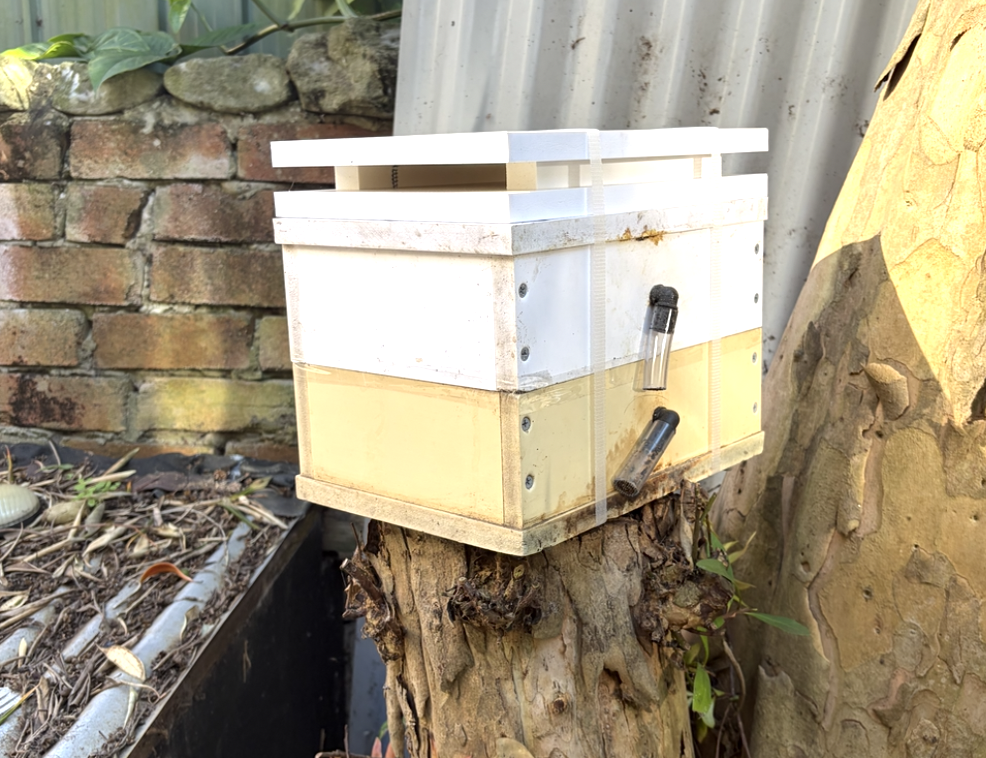
• Bee hive on top of stump; shaded from direct sun, almost no western sun, facing 40 degrees north east
Questions, comments welcome
If you’ld like to ask questions or comment please do here, and you’re welcome to email me too; michael@sustainablehouse.com.au
Yes - bees for plants, plants for bees.
Michael