by
Carly Casanova-Moore, intern with Sustainable House

Key points:
What do people think about key issues beyond sustainable houses?
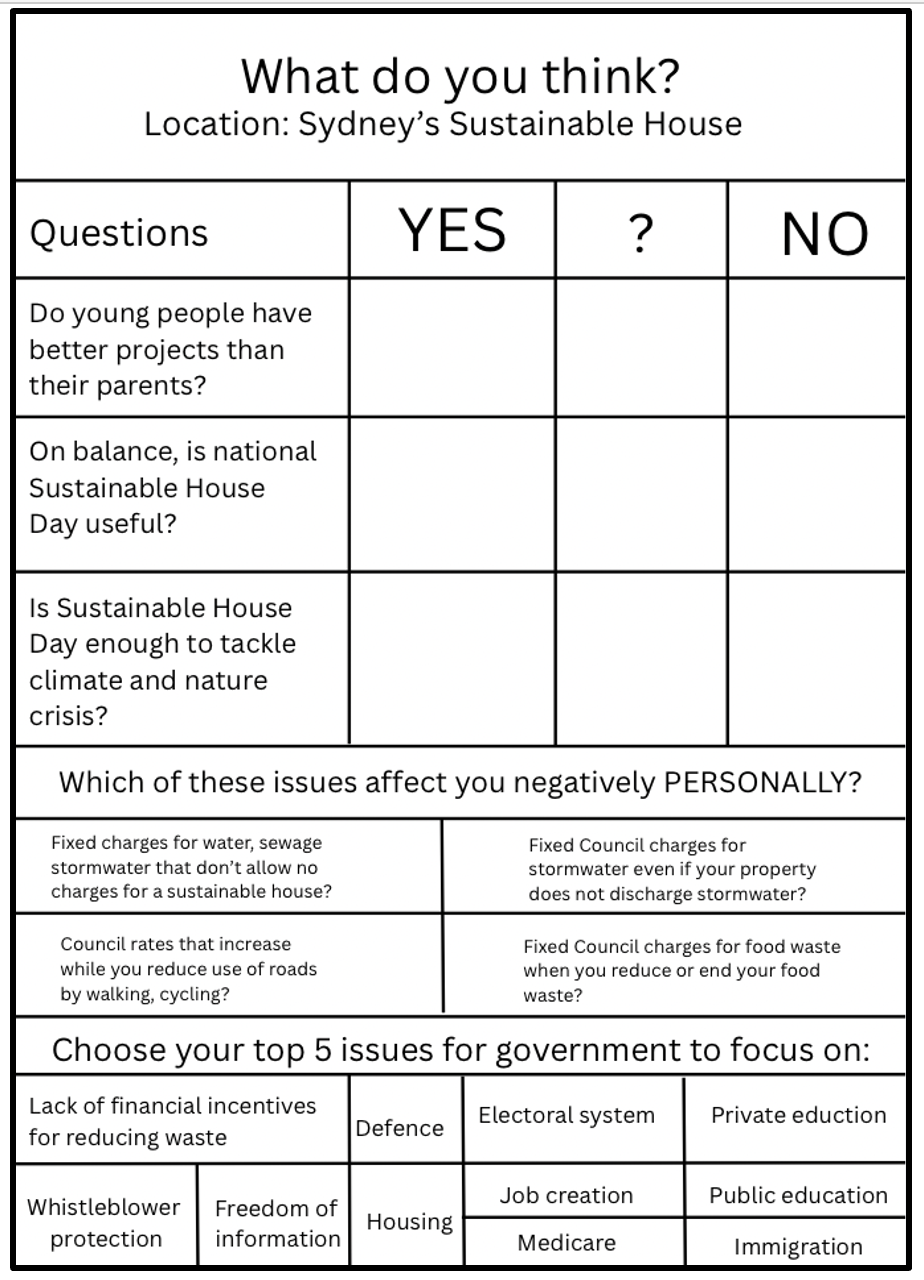
With three Sustainable House Day tours, Michael and I were able to implement a “What do you think?” board inspired by a UK group called Common Grounds, and want to continue improving it to be as effective as possible.
Try it yourself or work with your community to obtain anonymous feedback that provides a mirror of you and your neighbours and what you seek. Fill it out with the QR code above! Change the wording to describe your local issues.
Conversations
Participants of the tours engaged in conversations about solar panels and battery rebates, which led us to the Inner West Community Energy group as a valuable resource. We also discussed the impact of standing your ground when getting approval or building to live more sustainably - and how to do that.
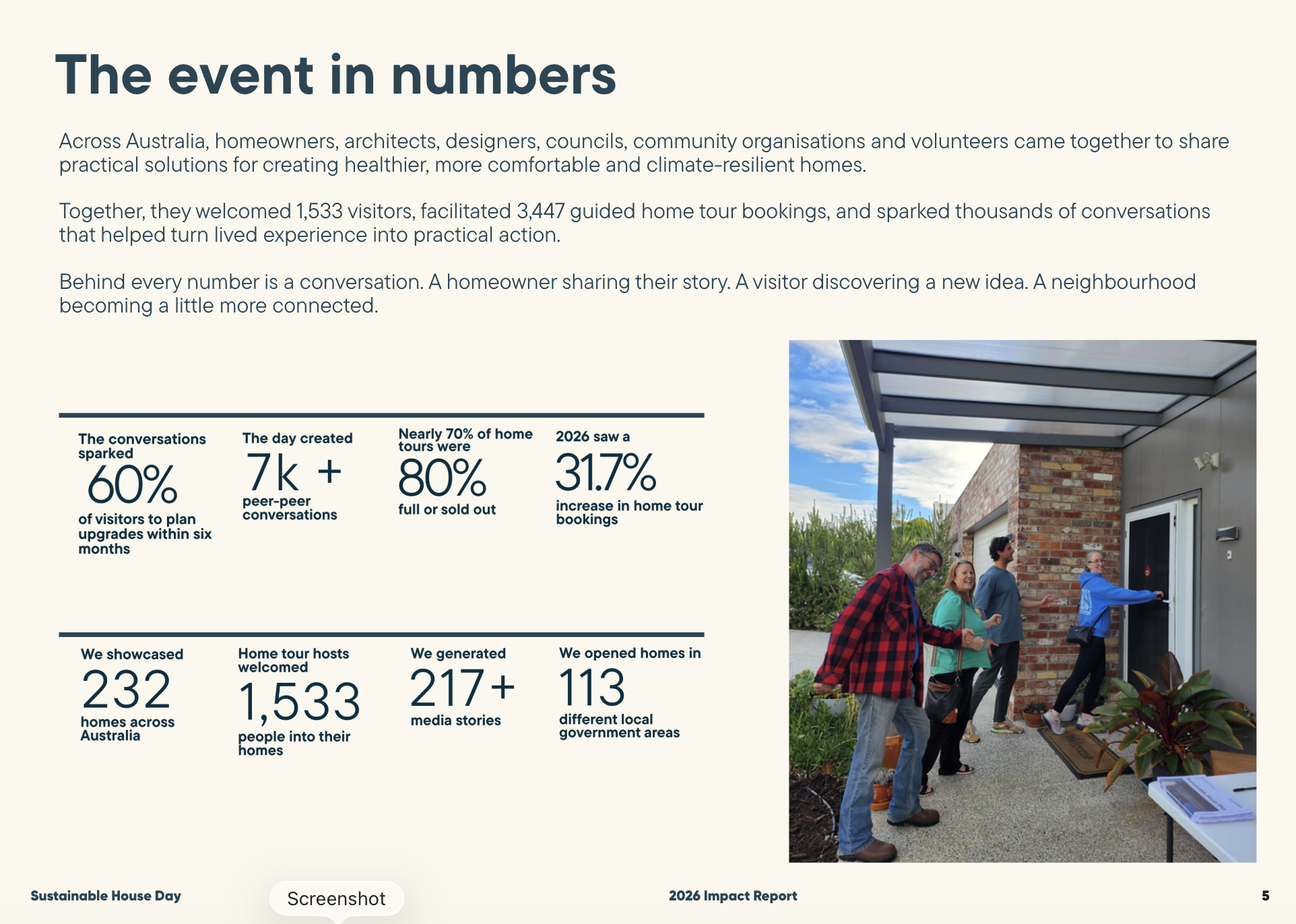
See the Renew Impact Report on the national Australia Sustainable House day at the end of this blog, or view it here:
Growing community conversations
Want to start your own conversations in your communities to discover what is important to you and your neighbours?
Start here with looking at Common Grounds for tips and suggestions: https://commongroundorg.co.uk/about-us/
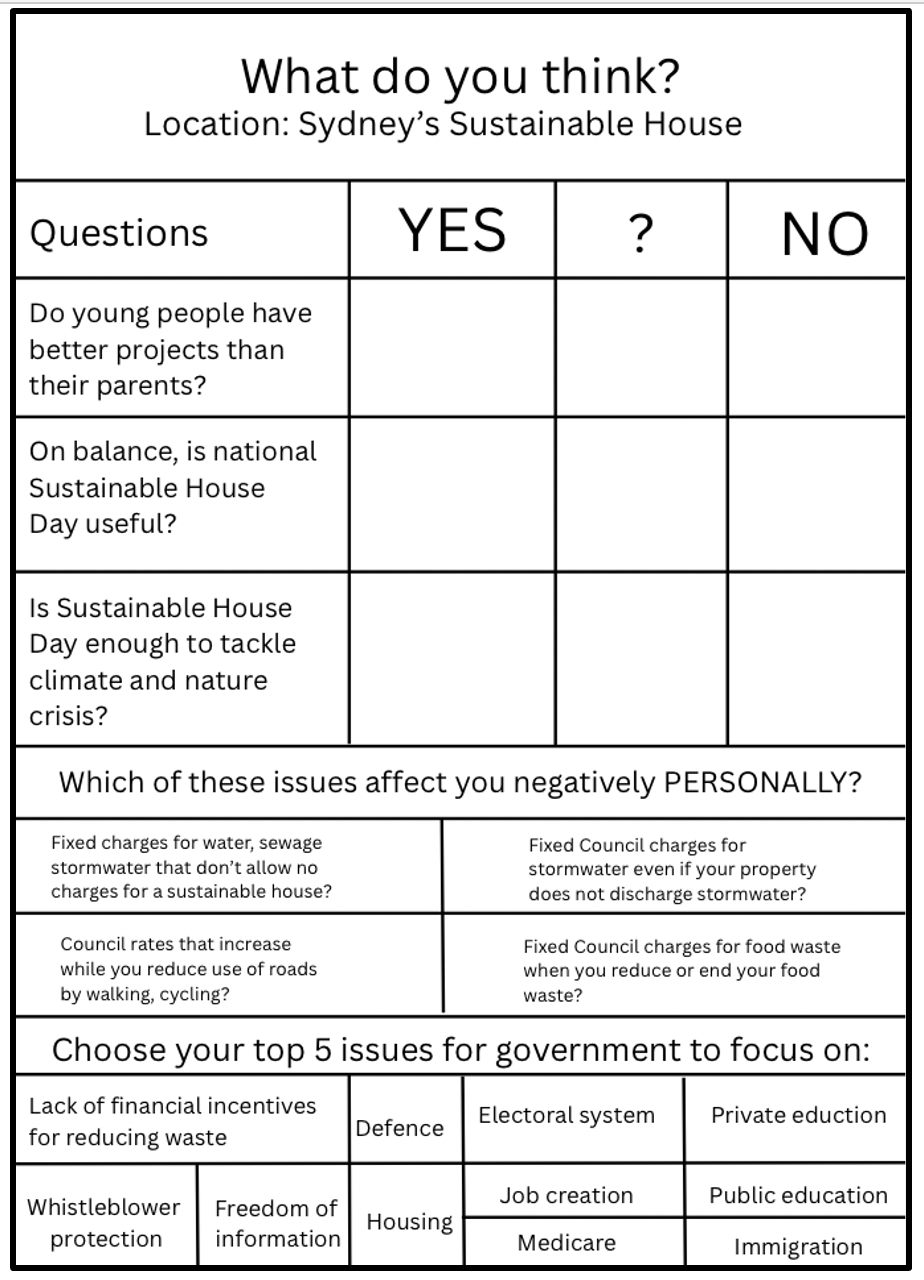
• The A1 size flip chart we put up and provided coloured dots for those who wished to to put the dots in the columns of their choice
Greeted by a nice sunny day for everyone, I assisted Michael Mobbs in three house tours for the national Australia Sustainable House Day.
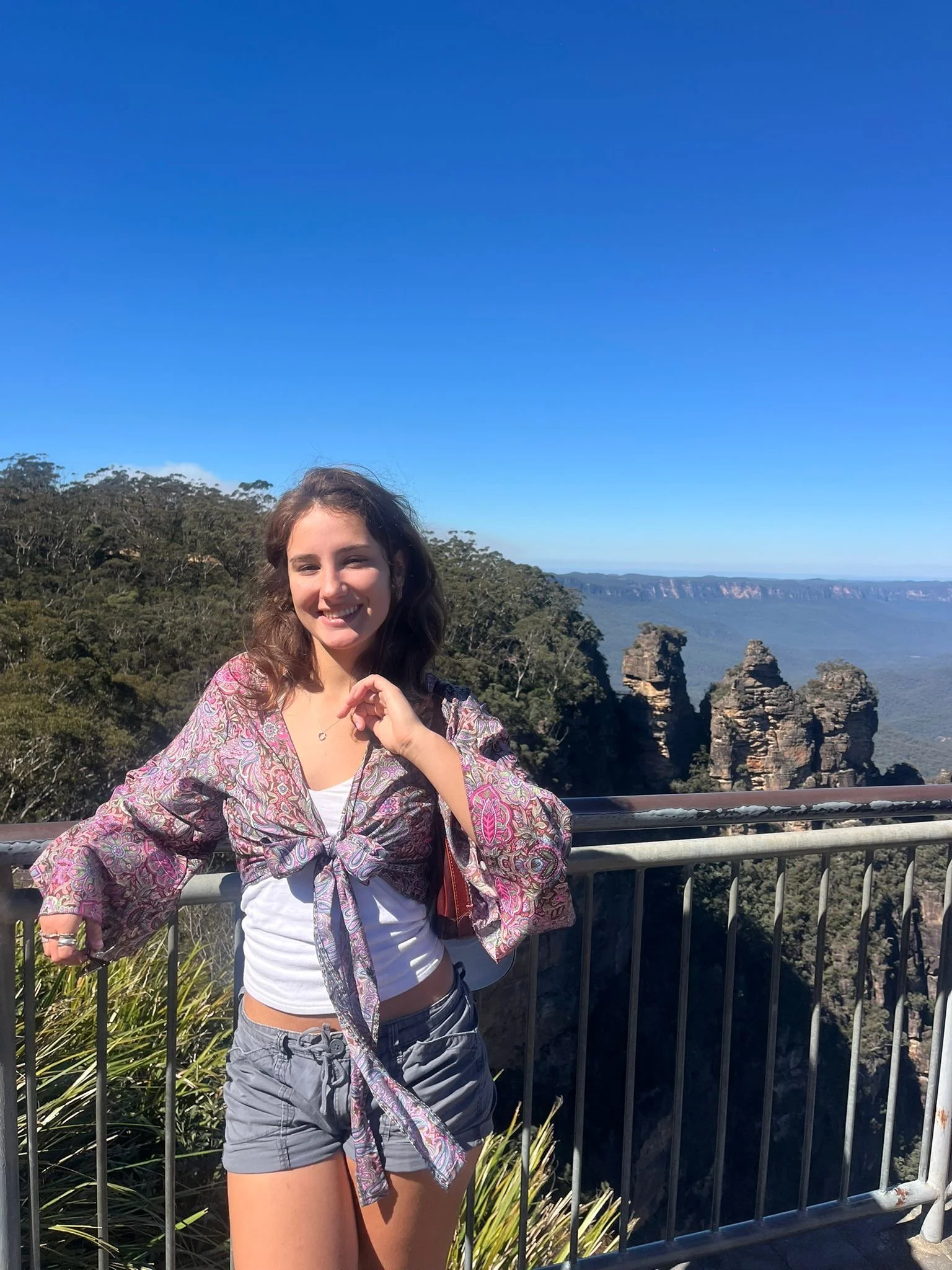
• Me and my Three Sisters - rocks, really - in the Blue Mountains, about 2 hours west of Sydney, Australia
Starting bright and early - well, 845 am, Michael and I drew up a “What do you think?” board, inspired by the UK Common Grounds volunteer team. Our aim was to learn what the people visiting from all over Sydney and beyond thought of issues beyond sustainable houses. Michael had learnt about this new tool for simply and cheaply obtaining anonymous opinions from communities from a recent column by the UK journalist, George Monbiot.
We put this board up with three “yes”/”?”/”no” options to answer questions, and two multiple choice opinion based questions.
These questions, answered by placing sticker dots in corresponding boxes, were put out to gauge the public's opinions regarding sustainable house day, and other more politically based questions surrounding sustainable living.
This social experiment allows contributors to remain anonymous, and in the UK has been put into place to understand what people want to see in the sustainability of their neighbourhoods with or without help from governments, regardless of their political party, wealth, poverty, personal circumstances.
The tours
The demographic of tour participants ranged from building design students to homeowners who are already running electric households, to people wanting to live more sustainably to 5 month old babies, and even a sustainable dog!
The crowd was mostly dominated according to how many sustainable events are, mostly caucasians over the age of 50. The crowd was sprinkled in with people of some other ethnic backgrounds, mostly south and east asian, and a handful of inspired young people.
Doubts were brought up about the first question on the “what do you think” board with feedback suggesting segregation of community was suggested in the question, yet even with an older crowd, the majority of the responses were yes, “Young people have better projects than their parents”.
I found these answers to be surprising, as most of the crowd was older, superficially indicating that they are the demographic of people showing up and being intentional about sustainable education.
I noticed that people were hesitant to put dots on the board, whether it be because of a smaller crowd with less animosity, or lack of understanding. I feel as though we could have more appropriately guided participants to organize the different colours of stickers according to importance, but we did not, and that was the most asked question.
After placing the dots, each tour began.
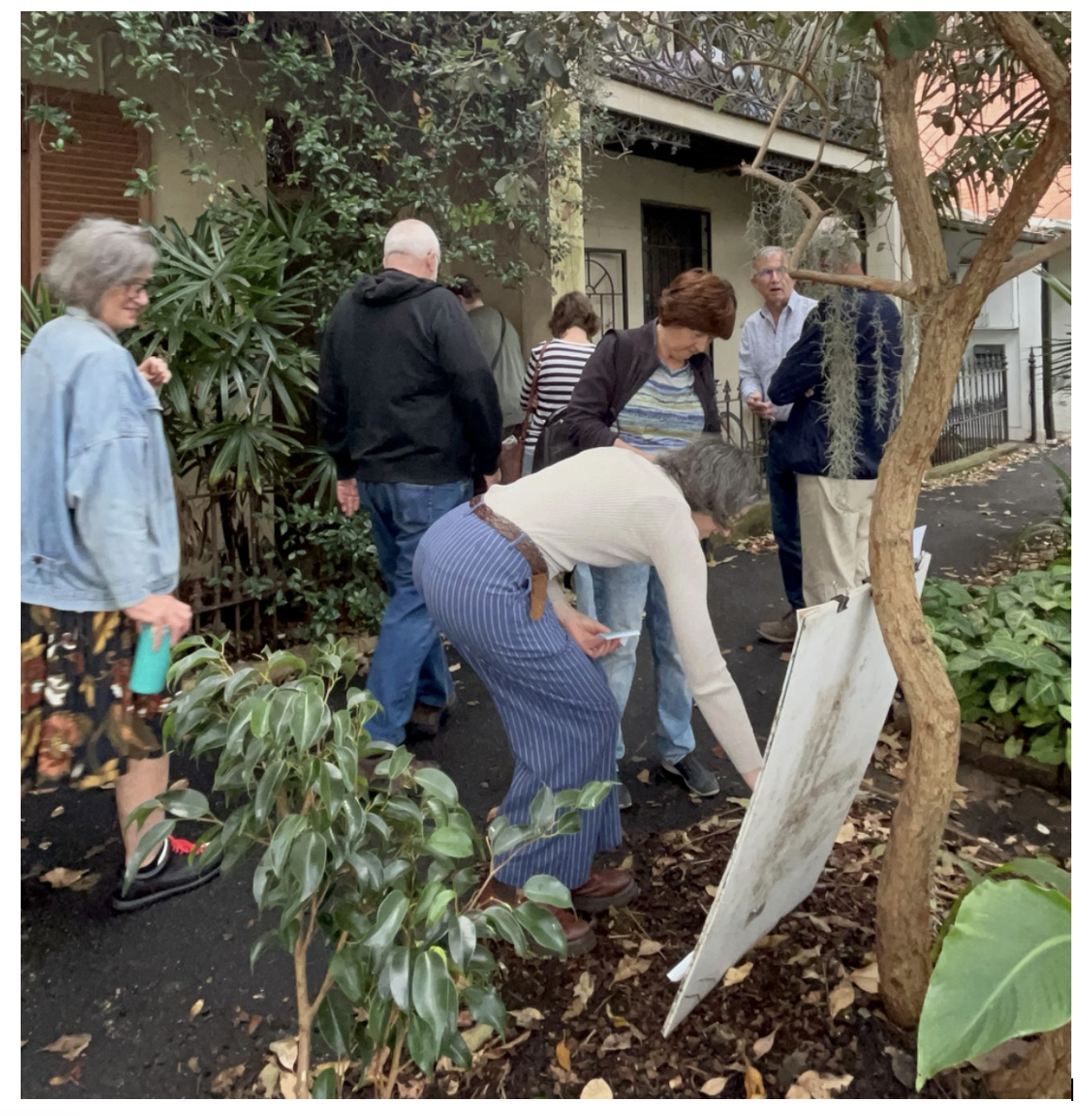
• Visitors going into the house and putting preference dots on the chart
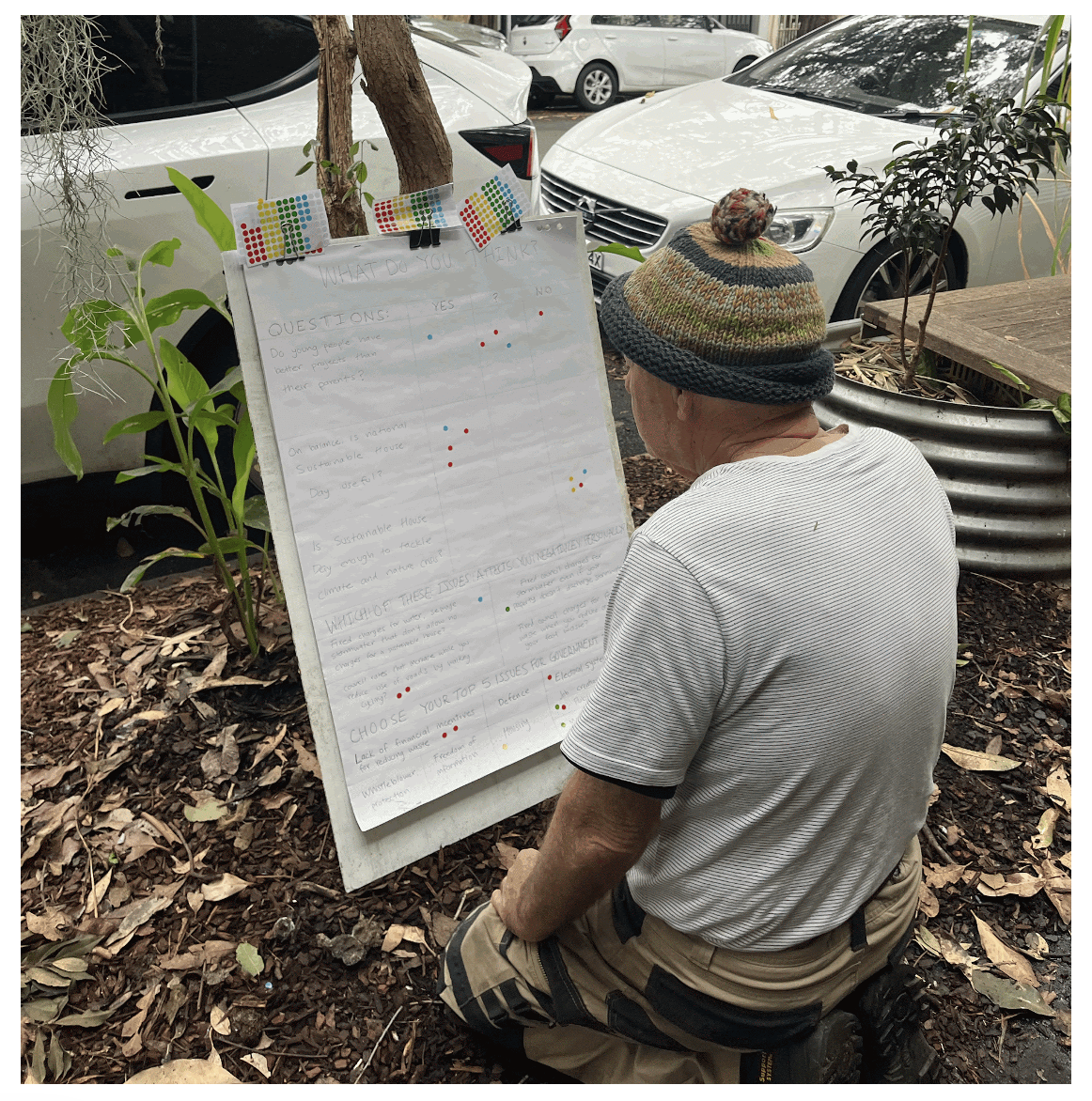
• Looking for the meaning of life aka what does a community prefer?
Excited to learn, people asked questions and shared their issues with trying to live sustainably, or standing up for themselves in this environment, something Michael really encourages, to assure that you are able to live the way that you intend.
One participant who already has solar panels on her house but needed to replace them as they were 20 years old, expressed her issues with finding a company that will be able to reuse her old solar panels due to rebates as she doesn't want to simply dispose of them. This was a good question that as someone who has never dealt with solar panels would not have thought of to be an issue. Amongst our amazing participants, a helpful resource was crowdsourced. Inner West Community Energy, who are a group of locals who are committed to helping their neighbors with energy and solar panel questions are a resource. They hold panels for community members to join. I found this a really nice idea because the experts in solar panels are usually the companies that are selling them, which means that information is usually given only with purchases and may not be objective.
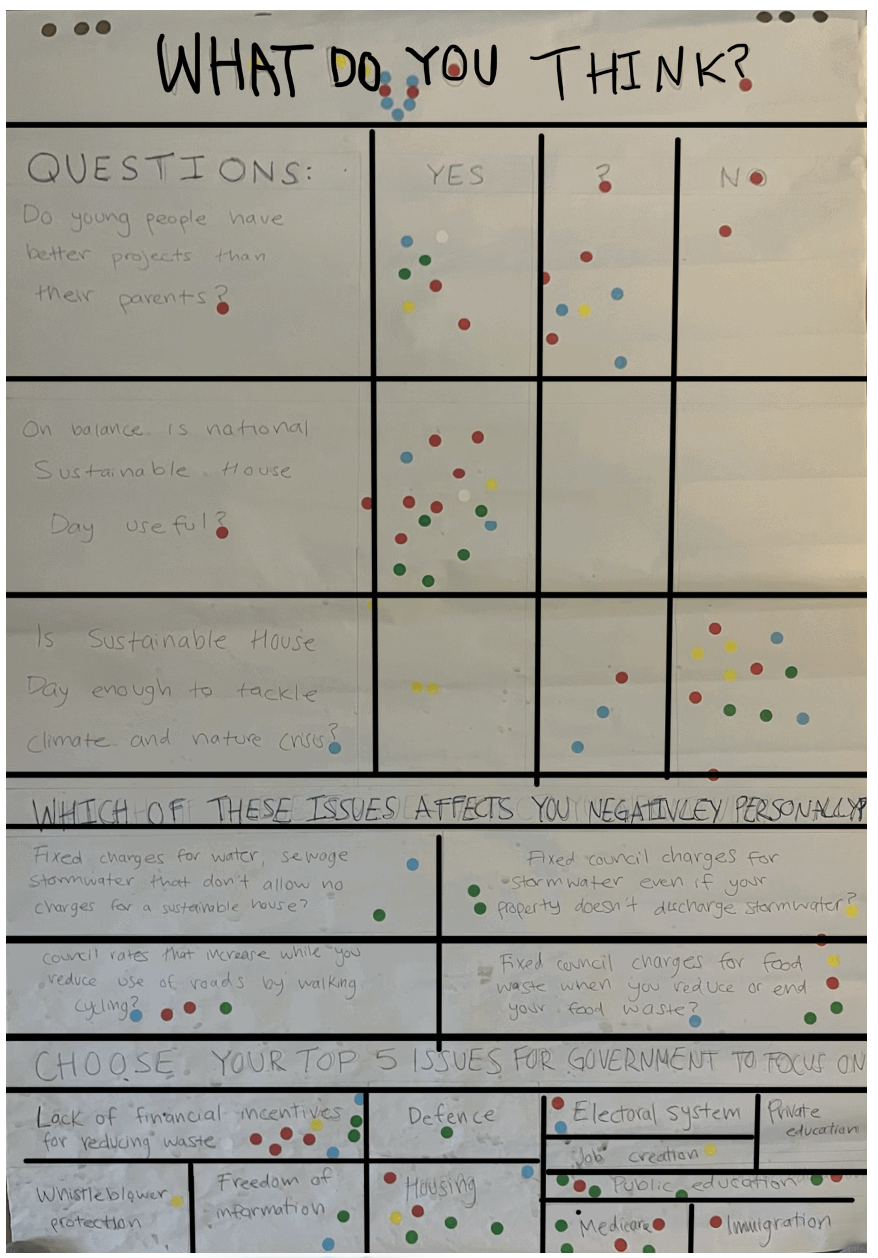
• How the coloured dots - showing priorities, preferences - were placed on the interests chart
There was another concern brought up about rebates for batteries for solar panels by another participant:
It is hard to receive help/ maintenance installing batteries after already having solar panels unless you have purchased from the same company because of rebates.
A few other questions and comments were sprinkled throughout the tours such as:
Do other councils also garden like Chippendale, with the answer being, yes, kind of, as some nearby councils have started more green initiatives but they are not as red tape free as in Chippendale.
• A couple of vistors strongly recommended this local group, Inner West Community Energy
A comment was made by a woman who came back to this tour after her first tour 20 years ago!
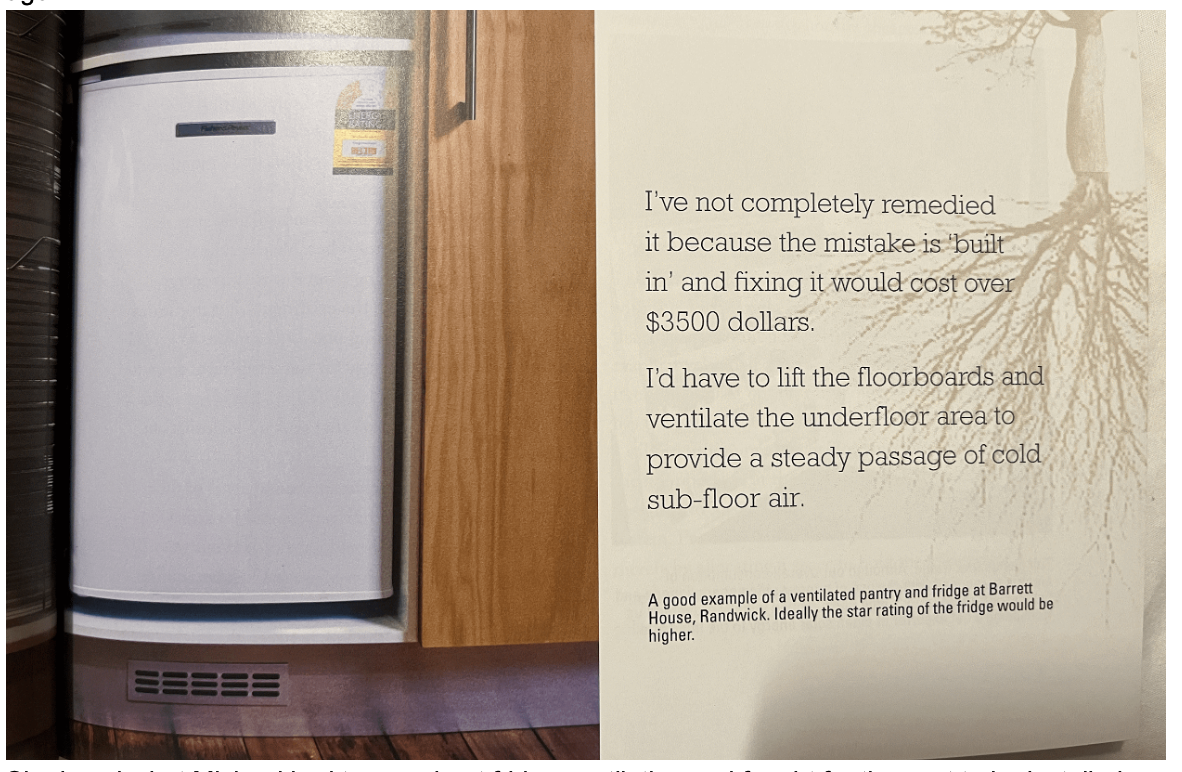
• Options to cool fridges by around or more than 20% using free cold air are described in Michael’s book, Sustainable House
She loved what Michael had to say about fridge ventilation and fought for the vent to be installed in her project after pushback from the builders. This is a huge thing for Michael - he stressed that as the money belongs to the customer the customer can insist on proven solutions and list, say, 10 of them as priorities for a project in any agreement. He has fought many times before to get to where he is now and encourages others to do the same. In his book, Sustainable House, he talks about how to do so.
Further reflections on the ‘What do you think experiment’
Before beginning the “What do you think” dot experiment, I believed that it would be an effective way to get participants interacting with Sustainable House Day and that we would be able to gain some valuable insights.
After setting up the board, and watching participants interact with it, I realized that there were issues with breaking the ice and getting people to actually engage with the board. I realized that a good way to start my next board is by placing my own dots and having Michael also place his dots as a way to make it less intimidating for participants to place the first dot. This behavior is exhibited often, such as when people are too scared to be the first to cut into the pretty dessert, so in the end nobody eats it.
After this, I believe that rephrasing my directions could be beneficial for gaining engagement as well. Rather than posing engagement as a suggestion or option, I could say “Please make sure to place your dots on the board and share your opinions before we start the tour” .
As some of the questions had political connotations, it could be possible that placing the board in a less central location would allow participants to feel more comfortable from not being watched and then associated with their opinions.
Looking at the data received from our specific board, we can see that participants both agree and are sceptical about whether young people have better projects than their parents. To me this means that the public believes that most change is in the hands of future generations, when we should all be working together, as all types of people can have good projects. It has been proven that ideas from diverse groups of people are usually more successful than from one demographic, because people are able to provide insight on struggles or experiences that support their communities, and in turn create projects that can target issues that may be unknown to other groups.
An example of this can be found in Aboriginal traditional ecological knowledge. When thinking about creating sustainable solutions, western society minds might struggle with finding a solution, when Aboriginal peoples have found this solution hundreds of years ago, but these ideas have been lost due to lack of education and acceptance and so on.
This shows how including more people into the conversation allows for better ideas and or projects. Everyone agreed that Sustainable House Day was useful, but most argued that it is not enough to tackle the nature and climate crisis. From my perspective as a student who has studied sustainability, these are great perspectives and shows me that participants understand that our climate crisis cannot be solved with one, simple, silver bullet solution, and that it takes change in many facets to create real, effective impact.
In terms of issues that affect participants personally, they felt that fixed council charges for food waste when you reduce food waste has most negatively impacted them. Compared to stormwater, sewage and transportation, this makes sense to me as composting and diverting food waste is a much more simple change to implement in your life rather than committing to making physical changes to your home, which cost a lot of money and take a lot more time. I appreciate that people consider reducing their food waste as doable in their daily lives, so working to reduce the council's fixed prices could encourage them to take bigger, more committed steps towards living more sustainably. This issue was also the top issue for the government to focus on, which is nice to see that a lot of people care about in hopes that they can work together on an issue that they care about to grow insights into how to achive systemic change in our communities.
by
Carly Casanova-Moore, Intern with Sustainable House