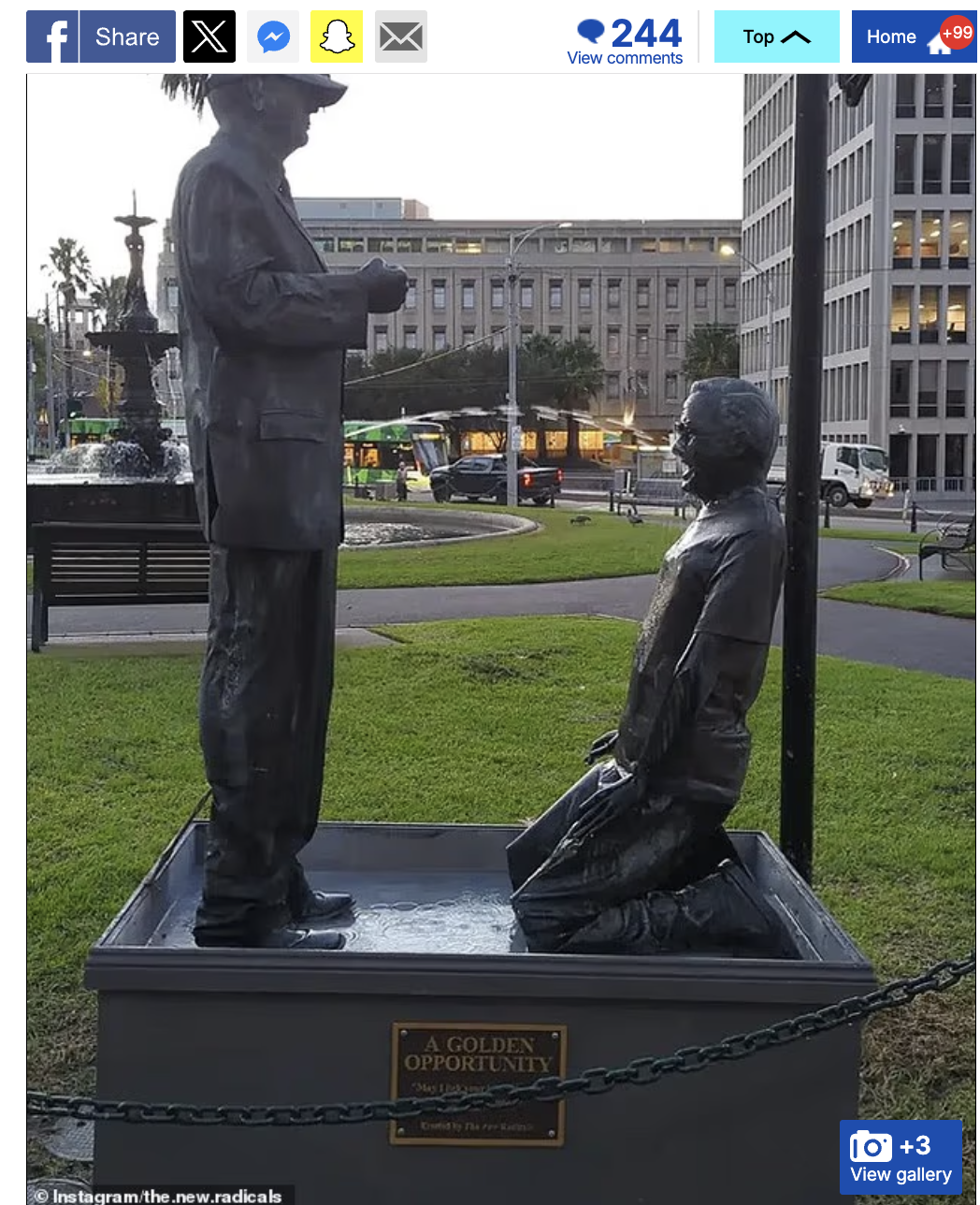
* A recent statue in Melbourne, Victoria, quickly removed by government
By
Michael Mobbs
For 76 years I’ve tried to show my love for Earth, to do her no harm. To respect and keep the air clean which she freely gives me to breathe, so too her water and rain, her soil and the plants and trees and all the little critters.
So what? Not much, really.
Gosh, we’re good at making a mess of Earth, the living thing which gives us life. Ancient cultures called her GAIA. Gaia is now having her revenge. Each day we attack ourselves and Earth’s climate which all of us live by.
We humans:
· grow air and water pollution,
· dig more and more coal, oil, gas,
· cut down more trees than ever,
· cascade plastics everywhere - into human semen, bodies, seas, town water,
· make more pesticides, chemicals to send extinct insects, birds, fish, and
· rob soils of nutrients.
I write what’s here not to whinge (well, maybe a bit), but by writing I can share some facts, reflect on my feelings, my observations. I’m seeking to explain to myself how and why I might keep going and keep doing what I do. Would I and Earth be better off were I just to leave it to Earth to finish what she’s doing? She has controlled her own game for millions of years and we cannot now halt what she’s doing in response to our abuse. She has no need for me or us, and our damage is too far gone to stop what she’s doing; our human journey has become our shared, inevitable collapse.
Please let me know what you think about the observations here - I welcome your comments.
The seasons to grow food, to fish, are going, and I expect food may mostly be lost to us before 2030. My data? Farmers and fishers, including those I buy food from at Carriageworks Farmers Market each Saturday; the sum of their stories – “It’s getting harder and harder to grow things. The weather’s all wrong.” As a farm boy I’ve learnt to distinguish between the “We’ll all be ruined” voices and the genuine, fact-based observations.
Science this year tells me the ocean and atmospheric currents which drive the seasons are breaking down and the risk is they will disappear soon. None of us may restore them. Most media are irrelevant.
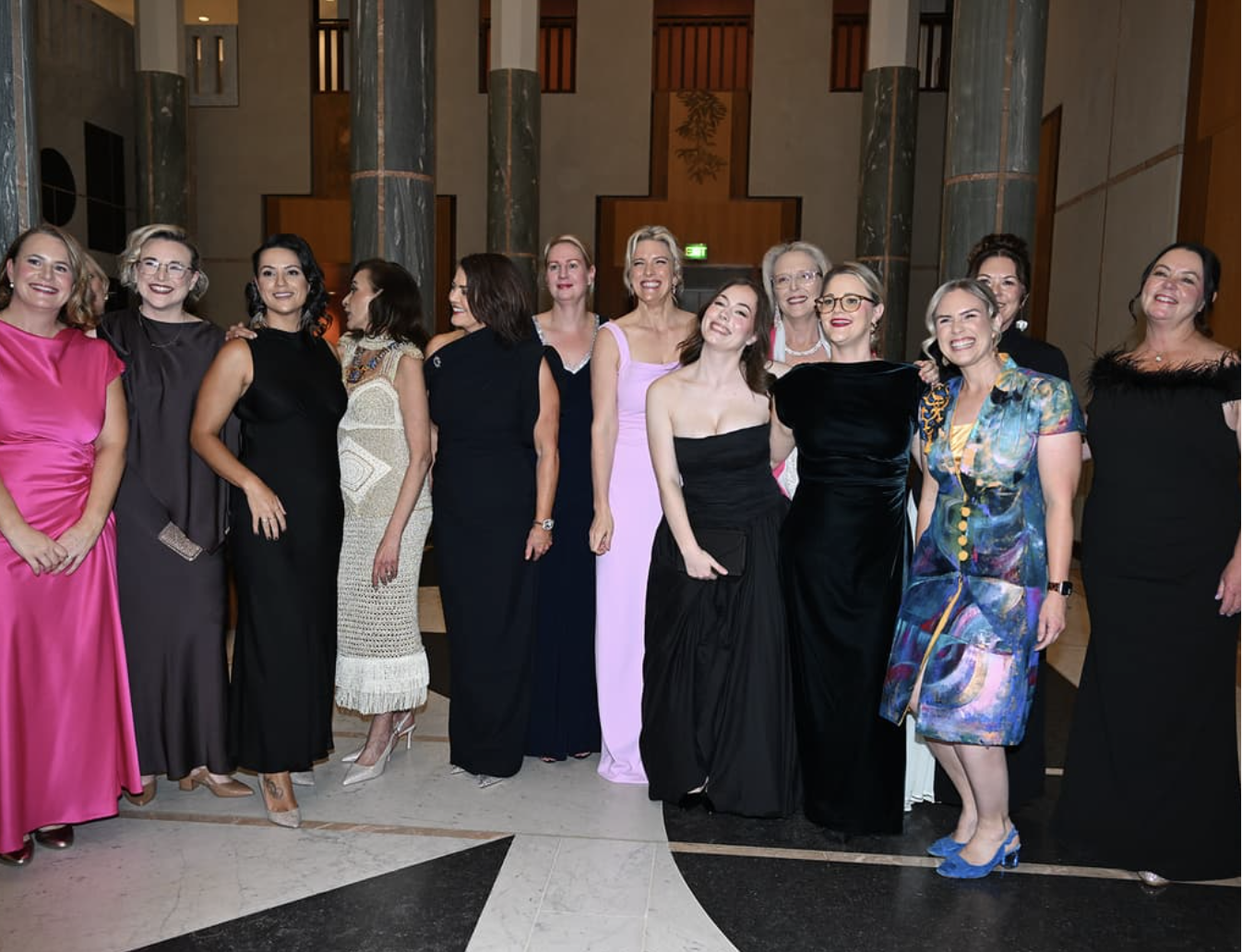
“Outdated and killing trust – all that’s wrong with press gallery’s night of nights
If there is one thing all leaders should be focused on, it should be maintaining trust. In our institutions and our democracy, and all those foundations which underpin it. Which is why it is so strange that the federal press gallery continues to hold its Midwinter Ball.” Amy Remeikis
What will the Federal Parliamentary Press Gallery Mid Winter Ball look like when there’s not enough food for the journalists there?
Doing things keeps me going, nourishes me, empties my mind. Gardening. Composting to make food waste into soil. Aerating the decaying food and carbon (newspapers, cardboard) with a compost auger. Marvelling at the beauty and magic of food decaying, the millions of invisible workers making soil. Reading. Cooking. Currently learning to make risotto, to stir the short grain rice (arborio, violone, or carnaroli) for 20+ minutes, adding stock and liquid gradually, ‘til the whole is slightly gooey, like volcanic lava.
So does music; Chopin’s Nocturne No 2 in C-sharp minor, Maria Callas, Beethoven’s last six quartets, Muddy Waters, John Lee Hooker . . . Some music sounds more of silence than notes. In tiny moments between the notes the listening and animal self I become then, briefly, is viscerally beautiful, not self or me, just a thing animate, sensing. Such are my joys.
Afterwards I remember Earth and the ways normal life has gone, is going.
I’m living two lives; a public, ‘normal’ one where I say little of what’s true for me, observe children and parents who will not live to my age – 76 – but expect to. Think that what they live in is normal. Have conversations where I don’t say what I think because it’s rare to find a fellow realist able to discuss collapse.
But many things that were ‘normal’ have gone from where I live. Today is not normal. In Chippendale the Willie Wag Tail birds have gone. The grass parrots are increasingly rare, will be gone soon. The Eastern Quel, or Stormbird, which once flew down to Sydney from Papua New Guinea in the spring to lay eggs no longer arrives, and their plaintive calls are no more – gone. Causes include; rat poison, fewer insects, bushes and trees, evermore city lights and, worst of all, those ever-growing introduced rats of the sky, and killers of Australian birds - the Tawny Frogmouth, Gang Gang, Superb Blue Fairy Wren, insects, animals - that vile Indian Myna. Young people today don’t hear the Stormbirds and don’t know they’re gone or existed. What’s natural for them is not for me.
For about the last 15 or more years I’ve been up and down about living in Earth’s abnormal collapse while around me those with families, kids, uni, jobs, babies, live and speak as though their lives will not be different, just better somehow.
Warning: oncoming alarmism
Let’s look at some ways Earth is collapsing because of governments, we humans, our Australian culture. Australia exports vast amounts of coal and gas which are killing the climate by changing the chemicals in it. Let’s acknowledge recent examples of Earth’s departures from ‘normal’.
Firstly, a recent abnormality is the collapse last month of Earth’s climate in France. It was followed by the collapse now in the US. In June, 2026, Parisians and all of France got a brutally learnt, month-long wake up when they couldn’t sleep most nights in their bedrooms, could only cool down by sleeping in parks or with wet towels over their bodies. No, this does not happen at this scale at this temperature for so long every summer.
Two Australian writers who live in Paris have blogged their observations and facts of their sleepless, stunned June lives; Sarah Wilson, here (some may read this as fear porn), and Rick Morton, here. Read them if you wish to get ready for the heat weather forecasters say is coming to Australia this summer.
An intern from the United States working with me, Gabriel Weitzer, has made a fact sheet from Sarah Wilson’s observations and it’s here. I’ve already said in answer to the question, “How can we stop this happening next year in Paris, the US?” - we can’t.
Does the prospect of a nightmare Australian summer this year give me hope that the federal and other governments will stop approving coal, oil and gas projects mostly owned by overseas companies who pay almost no tax for our resources, but do donate to the political parties? No. They’re bought and sold, lost to we citizens and captured by their masters; the coal, oil, gas, mining, gambling, property and technological donors.
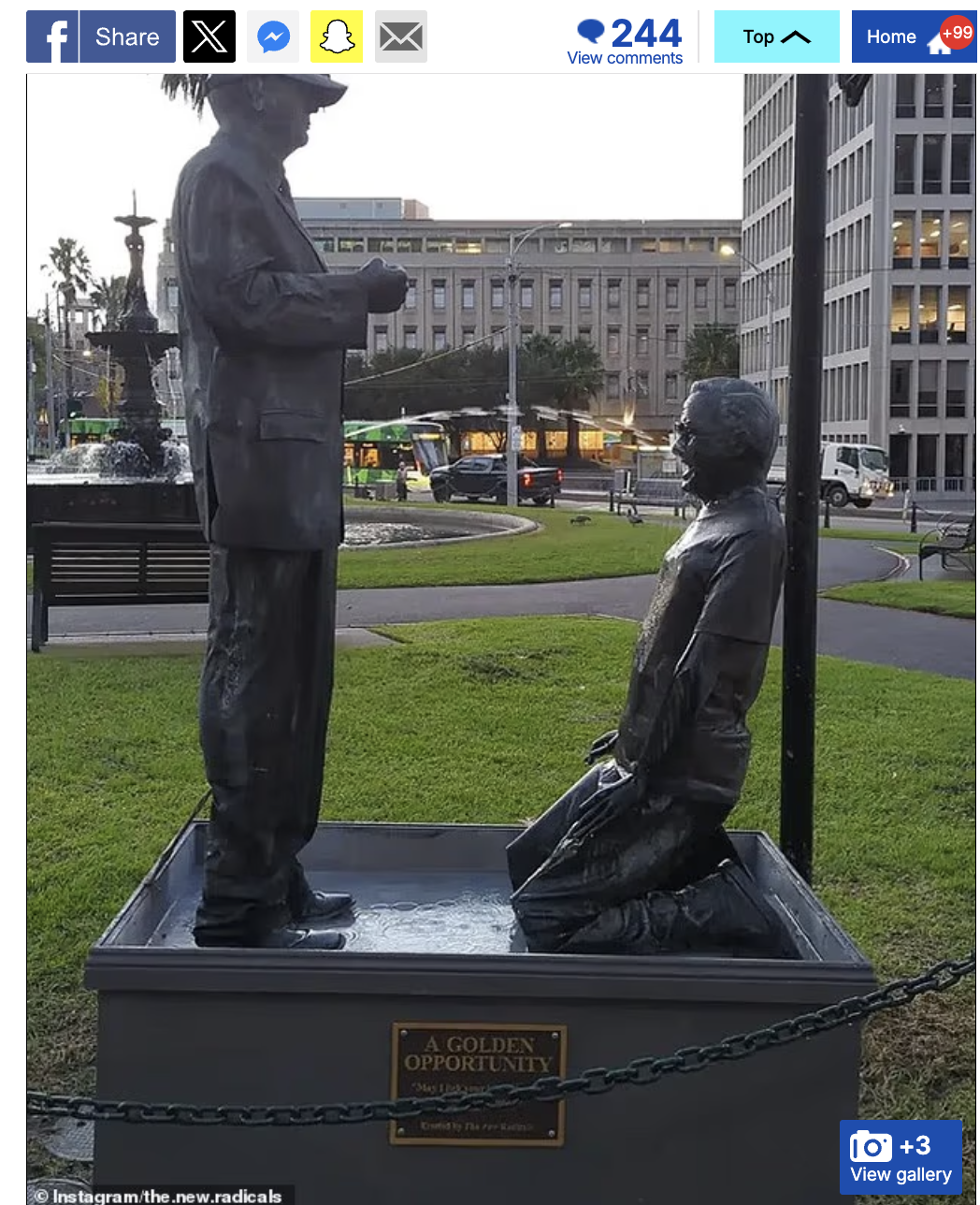
Secondly, there is a trend, a sense I have of some of us moving towards revolution. Some rebellions resonate with me, as does this recent statue in Melbourne portraying how Australia submits to United States’ directions for our military strategy, trade, and much more (the photo of the statue is above and the nameplate is below).
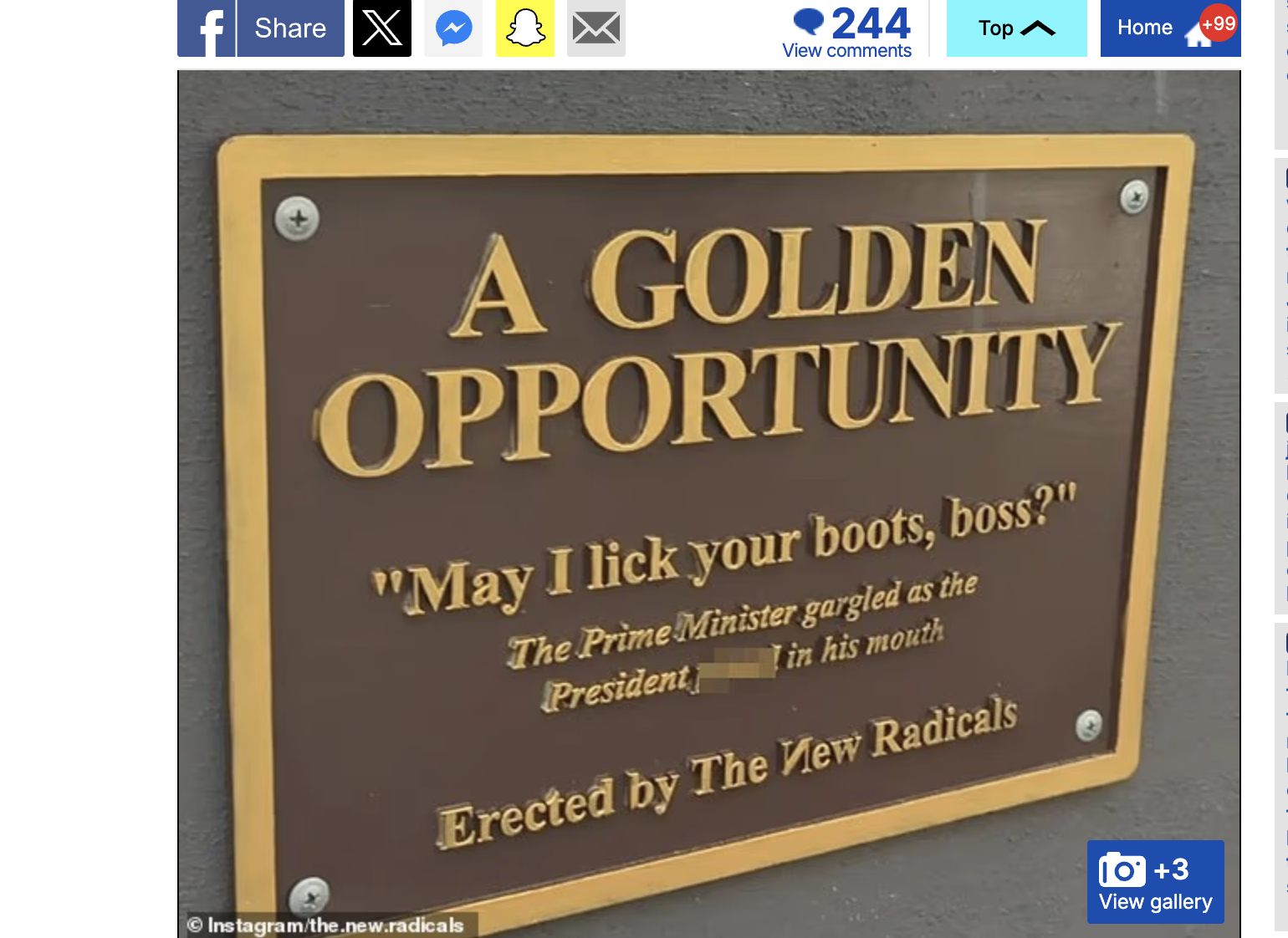
• Nameplate to the statue of US President Trump with Prime Minister Albanese kneeling at his feet
Thirdly, local councils make daily negative impacts on Earth’s climate. They ‘manage’ our waste, our streets, parks, and trees but are culturally unable to act quickly enough to make systemic or impactful changes to their climate polluting management.
Look at how Councils cause floods, waste rain and miss opportunities to cool cities with freely provided water from the sky that is lifted in the billions of tonnes by Earth’s clean energy system.
In the late 1980s, a series of storms and floods in the upper Parramatta River catchment, in western Sydney, NSW, led to the repeated inundation of many properties that had never flooded. The Parramatta central business district was twice flooded by over one metre of water. The events were the result of four local councils in the one catchment approving development without considering the cumulative impact of their decisions downstream. The state government set up the Upper Parramatta River Catchment Trust (UPRCT) to prevent future flooding. It forced the four councils to look at and remedy their combined impacts on the catchment.
In the late 1990s I was appointed by the NSW Government to review the Trust's performance in managing flooding and to advise on its future focus. I discovered a 78% failure rate in on-site detention systems designed and approved by the four Councils for installation on private land. I discovered no similar system applied to public land; neither the new freeways, schools, Council roadworks or other public land were required by the state government to include any on-site detention solutions; but those land holdings were also significant contributors to the flooding.
I recommended that such trusts and councils make greater use of rain tanks, rain gardens and other solutions be applied across catchments, and that the Trust be wound up. The government implemented some suggestions and wound up the Trust. But Parramatta remains vulnerable.
Over the last 15 years Sydney City Council has built 27 rain gardens in Chippendale where I live. They have a 100% failure rate, including the second and third renovations of some. In June 2026 I asked city Councillors to review the rate charges by which rain gardens are built, and to review the designs, but they refused, unanimously, seemingly convinced by an unusually passionate, jumbled speech by the CEO who opposed any changes including my proposed financial incentives for property owners to keep rain where it falls. The Parramatta catchment lessons have yet to be learnt here.
Fourthly, distractions and self-congratulations abound. From me, too.
There’s now a country-wide national “Sustainable House Day” initiated after I took my house off-grid in 1996.
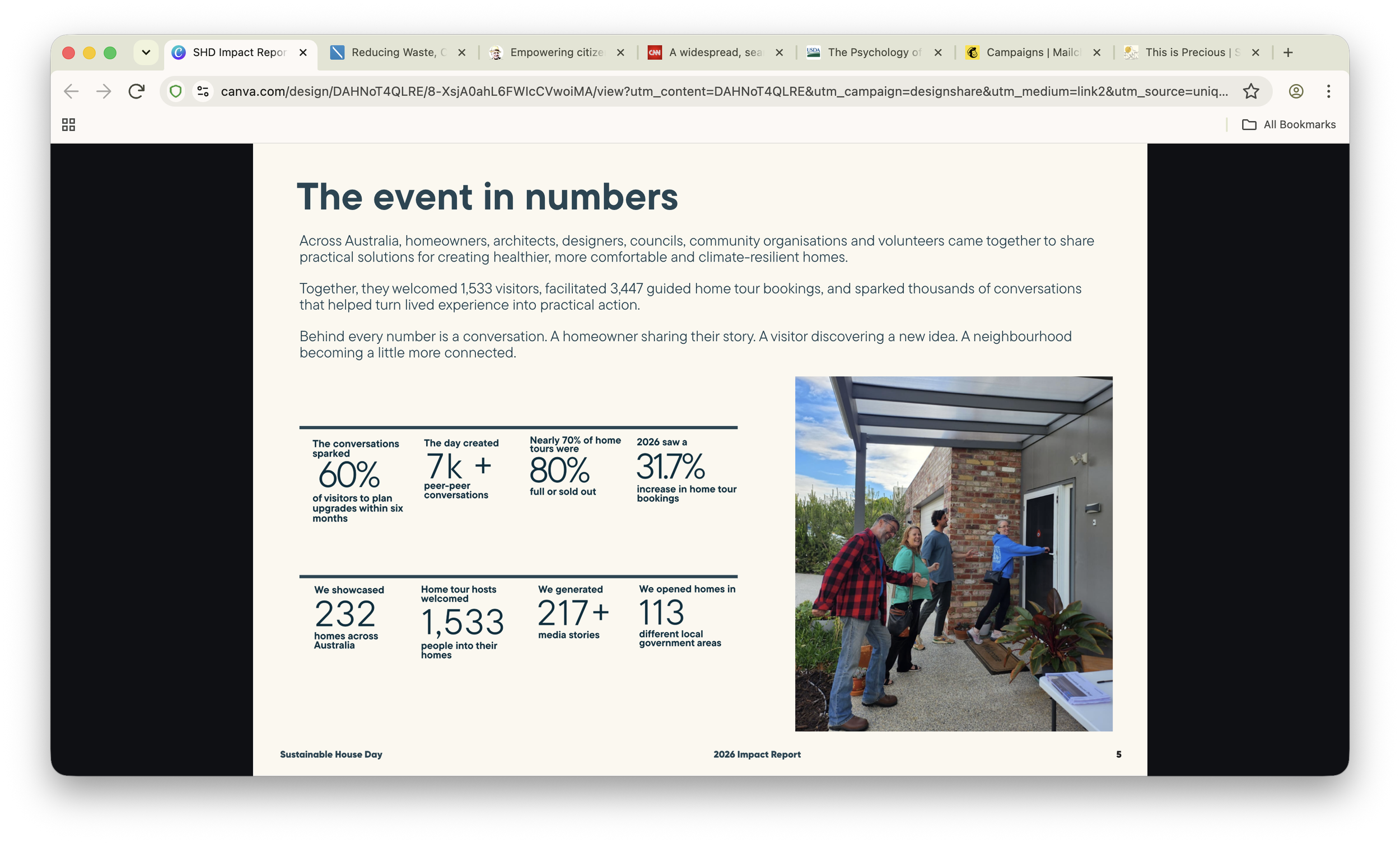
• Sustainable House Day Impact Report
Yes, this year’s event (17 May 2026) gave proof that 232 ‘sustainable’ houses were opened to the public and were visited by 1,533 people and 7k peer to peer conversations were created across Australia.
There are 27 million Australians and about 11 million homes, so sustainable houses and the people who live in them are a tiny portion. Almost all continue to put sewage into rivers and the ocean, to mostly use town water; whereas none has left my house for 30 years using very simple recycled stonework without steel or concrete. With the former NSW Premier who launched my house in 1996, Bob Carr, and a few of the wonderful people who’ve supported the project, we celebrated and shared some farmers’ food and conversations at a small dinner in the house in May this year. Thank you.
Sustainable houses and units are now in adjoining suburbs near my Chippendale one, in Redfern, Glebe, Darlington, Marrickville. But a new city entirely composed of ‘sustainable’ houses is not ‘sustainable’; more and more materials for them would be new, mined, dug up, transported, manufactured, not less from recycling.
Although the word wasn’t common in 1996 but is now everywhere, there’s scarce understanding of what is or is not ‘sustainable’. That word is now meaningless to me, devalued by greenwashing. No councillors on Sydney City Council, the CEO, the Mayor or staff could answer a question at the Council meeting on 22 June 2026 by Councillor Adam Worling, “Do we know how many houses like [Michael’s] there are in Sydney?”.
That question could not be answered by any in a Council with a billion-dollar budget in 2026, 30 years after I went off grid, whilst no water or sewage has left the house and all the energy and water for it is from the sky. The house was used in the NSW government Cabinet discussions to support the introduction in the 1990s of minimum thermal performance, energy and water efficiency standards that were mandated in the design of new housing and units (BASIX). But 30 years later Sydney City Councillors and staff don’t know that history or how many sustainable houses there are here, and don’t research it.
Each day Australian Councils make thousands of decisions about housing, land, water, energy, transport, waste which increase climate, water and waste pollution. Many have ‘sustainability’ policies. Seven years ago, in 2019, Sydney City Council, along with many other Australian councils, declared a ‘climate emergency’. Watching it these last 7 years is like watching grass grow. Yes, it’s done some things but it’s unable to end its climate pollution and won’t say so in its reports.
Get this: Sydney City Council buys carbon offsets for the climate pollution it hasn’t stopped, mostly from overseas projects many of which are in China:
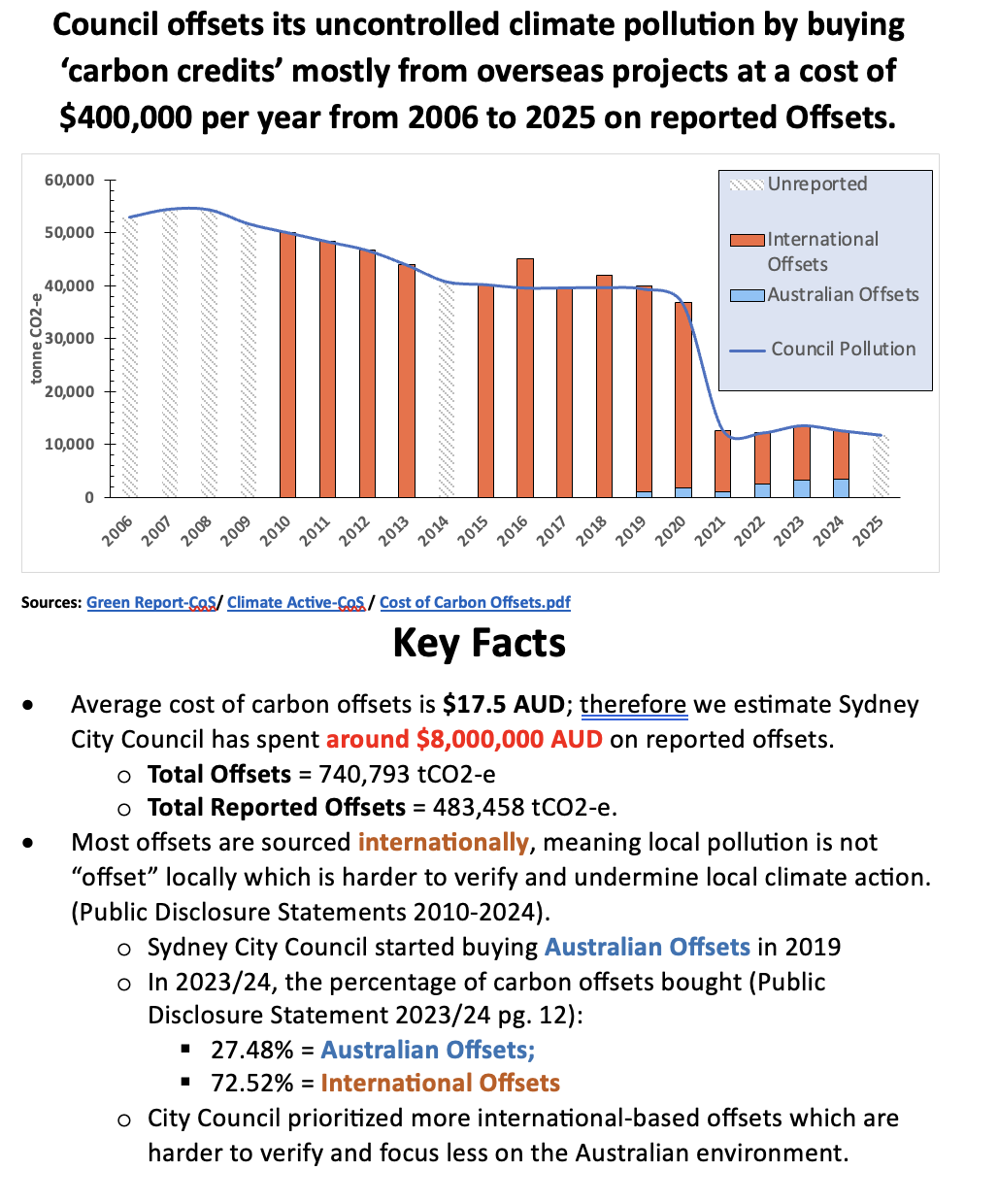
• Sydney City Council data shows most of its investment in carbon offset project are in overseas projects
• 1.76% carbon offsets were spent on Australian-based offsets, 62.73% were spent on International-based offsets, and 35.50% spent on unreported offsets.
• Only 64.49% of the total estimated costs were reported from 2010 to 2024 and 5 years of unreported data (2006,2007,2008,2009, 2014).
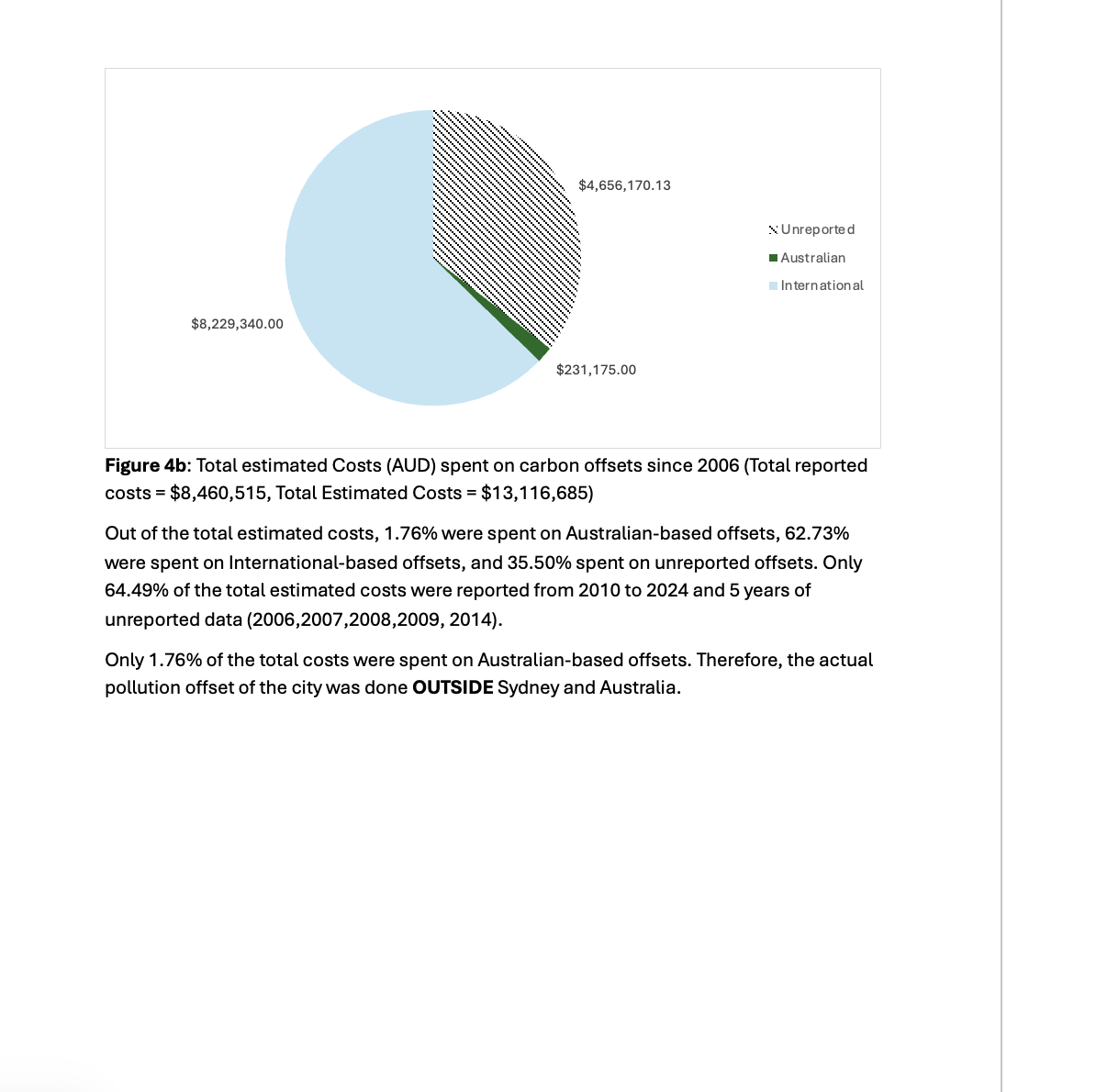
• The data shows:
- In 2023/24, the percentage of carbon offsets bought (Public Disclosure Statement 2023/24 pg. 12):
§ 27.48% = Australian Offsets;
§ 72.52% = International Offsets
o City Council prioritised more international-based offsets which are harder to verify and focussed less on the Australian environment.
Meanwhile, the Council claims in reports, submissions, newsletters it’s ‘carbon neutral’ - ie doesn’t, on balance, add carbon to Earth’s atmosphere.
It does not state it has contracted out its most polluting actions to contractors so it can say that any carbon pollution is by the contractor not the council. All the Sydney City garbage the council contractor collects for the Council, the pollution from the trucks stopping every 10 metres and the stuff in them, is the responsibility of the contractor, not the council.
I wish I could contract out my climate pollution.
False and misleading self-promotion dominates. My local council deludes itself and its community; says of itself every week in websites, newsletters, media that it’s world-leading, ‘sustainable’, ‘innovative’, ‘curious’.
It prioritises centralised systems which increase climate pollution and are near impossible to undo, such as its new system to collect food waste which will increase pollution and, as substantial research shows, will drive up household costs and food waste.
Look at the Council’s ‘values’ on its website: ““Our 3 values are crafted by our people” . . .
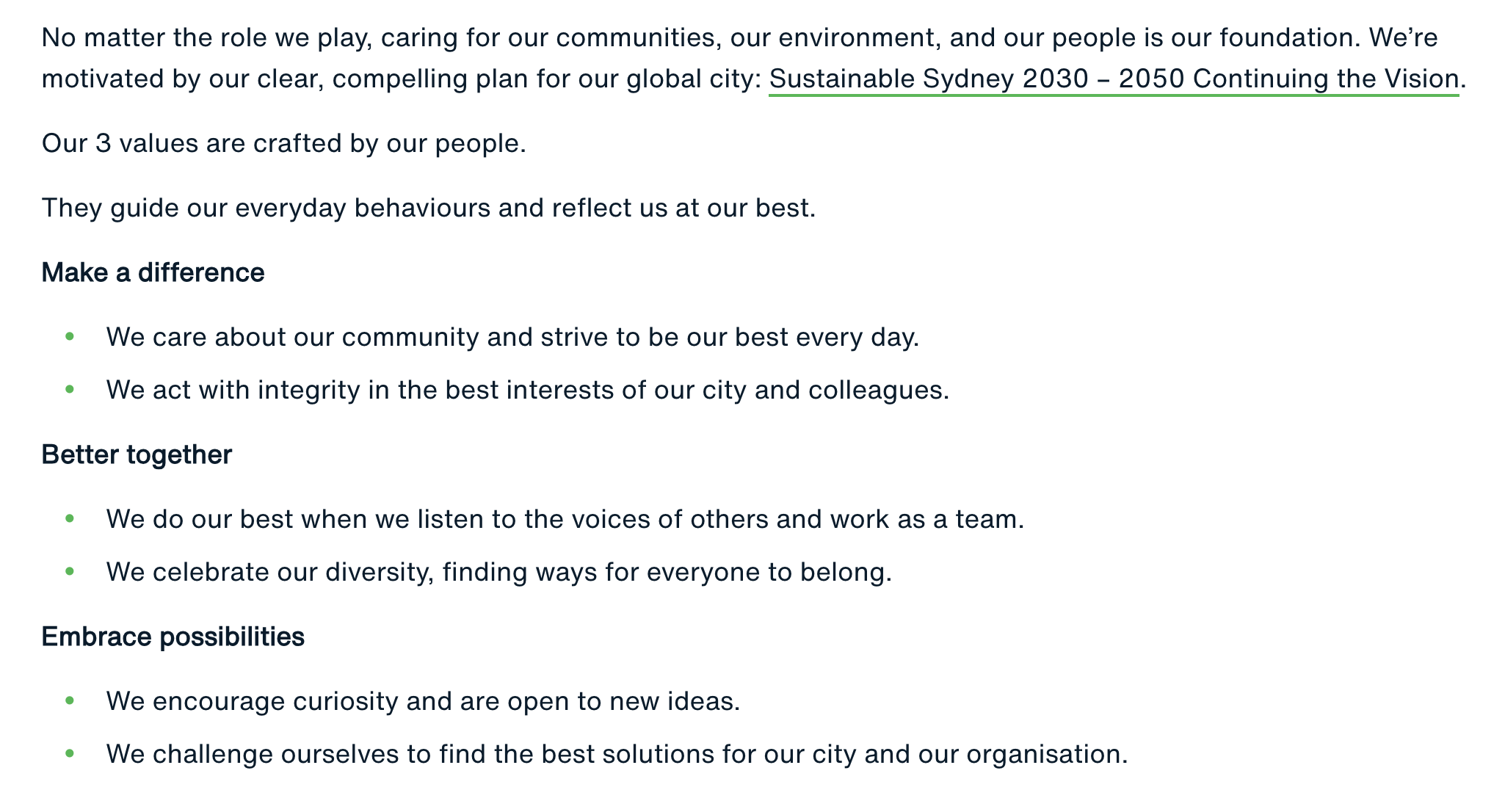
• Council’s values: “Make a difference”, “Better together”, “Embrace possibilities”
Fifthly, Australia’s private sector is motivated by insatiable greed for money, not respect for Earth or her natural systems which give life to us.
For example, the big investment sector, the superannuation companies, shows almost no leadership.
As at July 2026, according to The Guardian, greed is the priority of the biggest superannuation fund, AustralianSuper, as the: “$388bn fund manager with 3.7 million members is now the single biggest investor in Whitehaven, which operates six coalmines in New South Wales and Queensland and is developing more.” Six years ago the fund said it would invest in line with the UN’s climate goals to reduce climate pollution.
Sixthly, in Australia we’re dominated by financial greed and self-deception.
Australia - we’re persuaded we have a right to exist; ‘we’ being mostly white, middle class people. We white-ish persist with our ongoing genocide of indigenous people, continue their deaths in our prisons. They’re ignored as is the real-time genocide of Palestinians by a state whose practices copy those of the genocide-focussed German state during WW2. Australian indigenous people inspire me with their humour, resilience, light-heartedness and friendship to each other and, amazingly, towards many of we white colonials, despite our continuing genocide. When collapse occurs and we experience hardships similar to those we impose on indigenous people I hope to be as resilient as they have been.
Do we reckon we have a right to survive? Are we certain of our brutally-won wealth and comforts, electric cars, shopping malls? That we’re “all good”? That we deserve what we’ve got and more?
Meanwhile, across Earth some 2,000 climate scientists say there’s no global warming crisis. Ok. That’s a load off my mind.
Still, I trust the farmers, fishers, my eyes and senses as I see natural systems collapsing all over Earth because of us – you and me. I include myself and my well-intentioned moment in 1996 when I called my renovated terrace a “sustainable house”. Later I discovered the growing, production and waste of food caused far more pollution than my or any other house does. Now I focus on ending food waste. Chippendale and Sydney City Council combined to make what I reckon has inspired and liberated many of us in the city, a one page policy allowing any of us to garden in the footpaths without Council approval.
Where to from here?
Well, there’s this warning against certainty: “One thing that being a scientist has taught me is that you can never be certain about anything.” James Lovelock, author of The Revenge of Gaia.
Am I ‘certain’? Not quite, because:
“Uncertainty is an uncomfortable position. But certainty is absurd”, Voltaire.
I wonder, bemused now by my own seriousness here, how is your boat going? Are you adrift like me?
“And so we beat on, boats against the current, born back ceaselessly into the past”, The Great Gatsby, F. Scott Fitzgerald
What do you think?
By
Michael Mobbs, gardener
Note: Sources are in the links in the text