
Key points
Read on for answers to these questions:
· How raingardens grow plants, trees, cool streets, cities
· Why, and how, have I kept over 2.5m litres of rain water and sewage in the small raingarden of my terrace house in Chippendale over the last 30 years? None has left the site.
· Why do Councils fail to audit their failing rain garden designs, or discuss their design with the communities who live with them?
· How can a council – or anyone - audit raingardens they build with public money and get raingardens to keep rain where it falls?
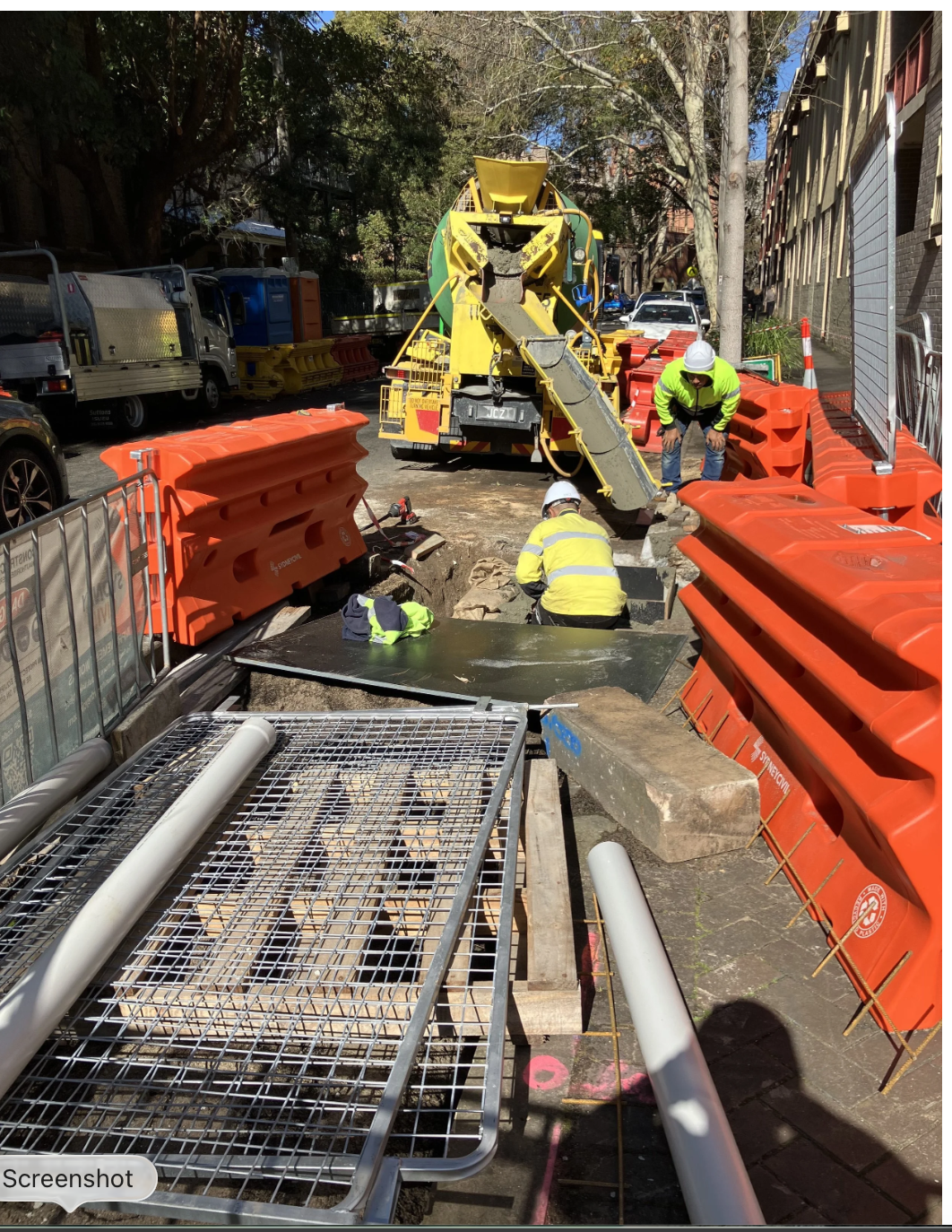
• This is not a raingarden being built in Chippendale, but Council says it is
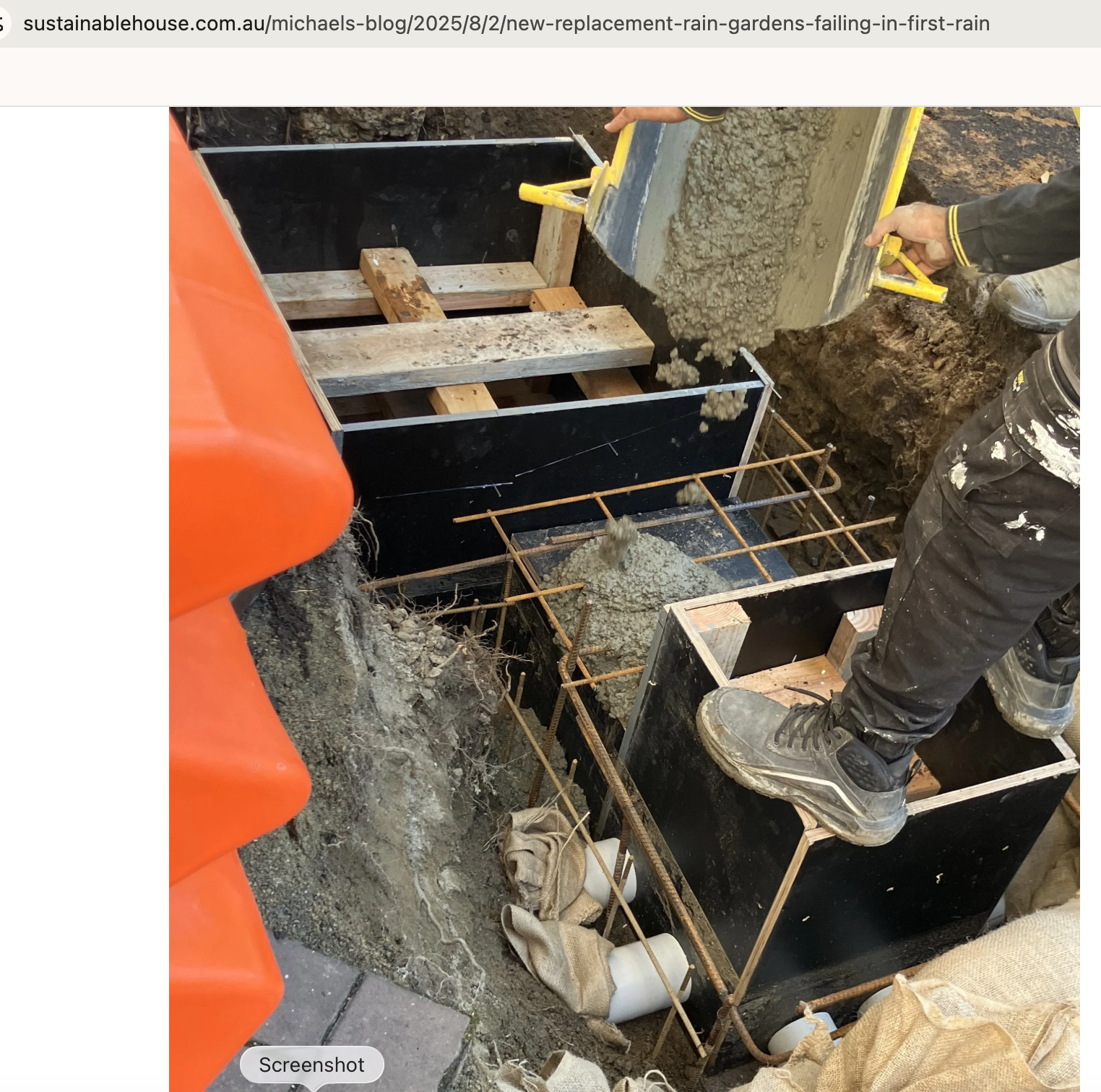
• Timber, steel and concrete in the installation in Buckland street
Sydney City Council engineers who design and built the thing above in Buckland Street, Chippendale, call it a raingarden.
No, that’s a garden of steel and concrete. This one took three weeks to build and about ten construction workers with utes, trucks and many vehicle trips. And it didn’t work in the first rain as I stood in the steady rain and watched it fail to keep rain which drained away to pollute Sydney Harbour.
I explain in a video made of this project during rain why these installations are not raingardens; an excellent time to know the truth about a raingarden is to stand in the rain and watch to see if it keeps rain where it falls. Or, a Council - even an engineer - could get a water truck to mimic rain and spray water into the gutter and road to feed an installation and see what happens. But as far as I know engineers don’t audit with water trucks their raingarden designs and how effective they are at keeping water on site.
What is truly a raingarden?
Raingardens are quick, simple, cheap and powerful ways to quickly cool cities, restore soil, plant and tree life, marine life and to keep humans alive and healthier in hot summers and, year long, with cleaner air.
Below is a raingarden (no concrete or steel) at my house.
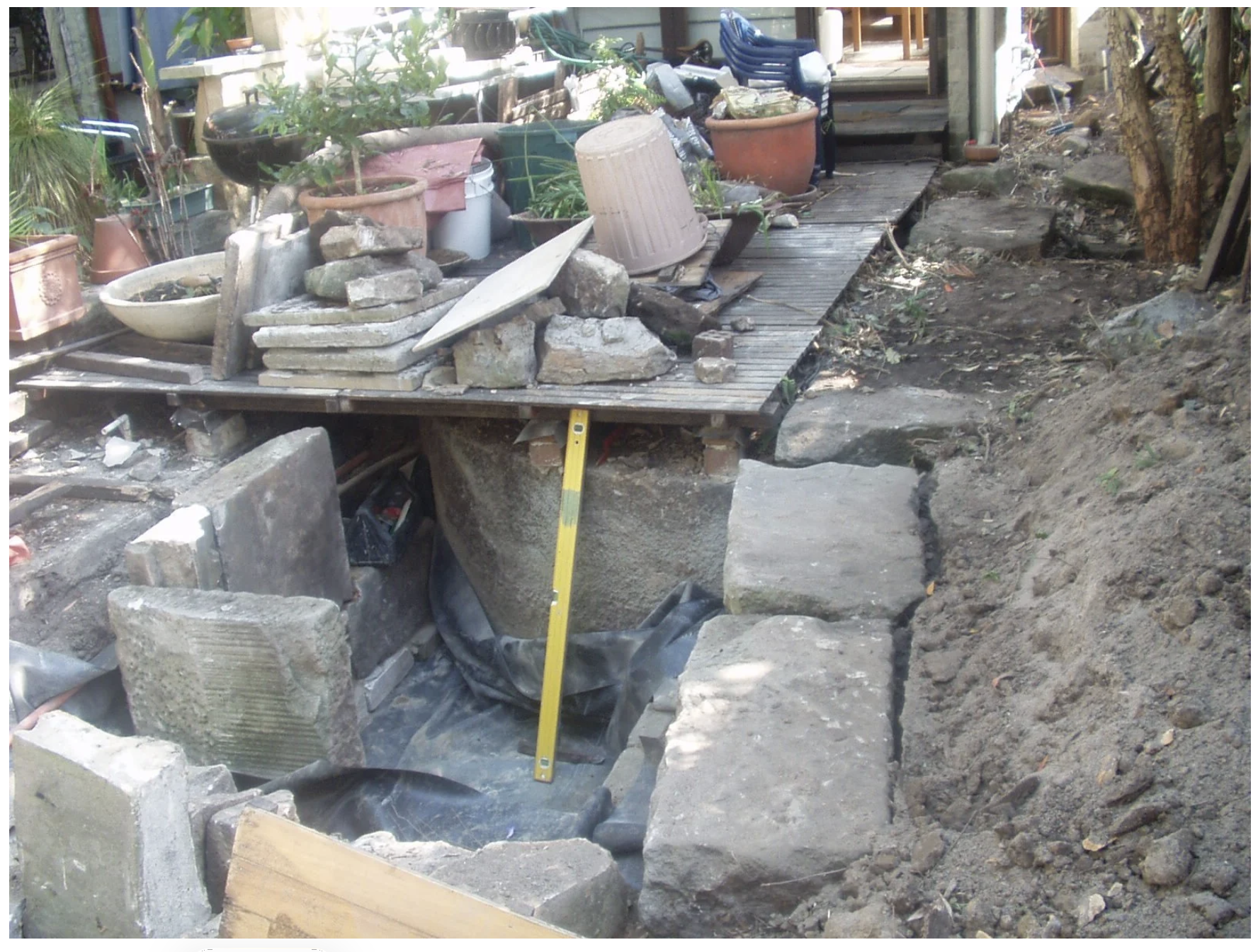
• Rain garden, also known as a ‘leaky well’, keeps all overflow from the 10,000 litre rain tank below the deck at Sydney’s Sustainable House; a plastic storage basin at the base holds about 200 litres of water for frogs to breed and live in. There are no frogs in Council ‘raingardens’. No water or sewage has left in 30 years; over 2.5 m litres of water and sewage has been kept on the site.
My raingarden is made of recycled sandstone blocks. No grout or concrete is between the blocks so the rising water from the rain tank overflow is absorbed sideways through the blocks into the adjoining soil and trees and garden in which there are clay lenses or clay patches.
Cost: two days labour, $1500 for the materials
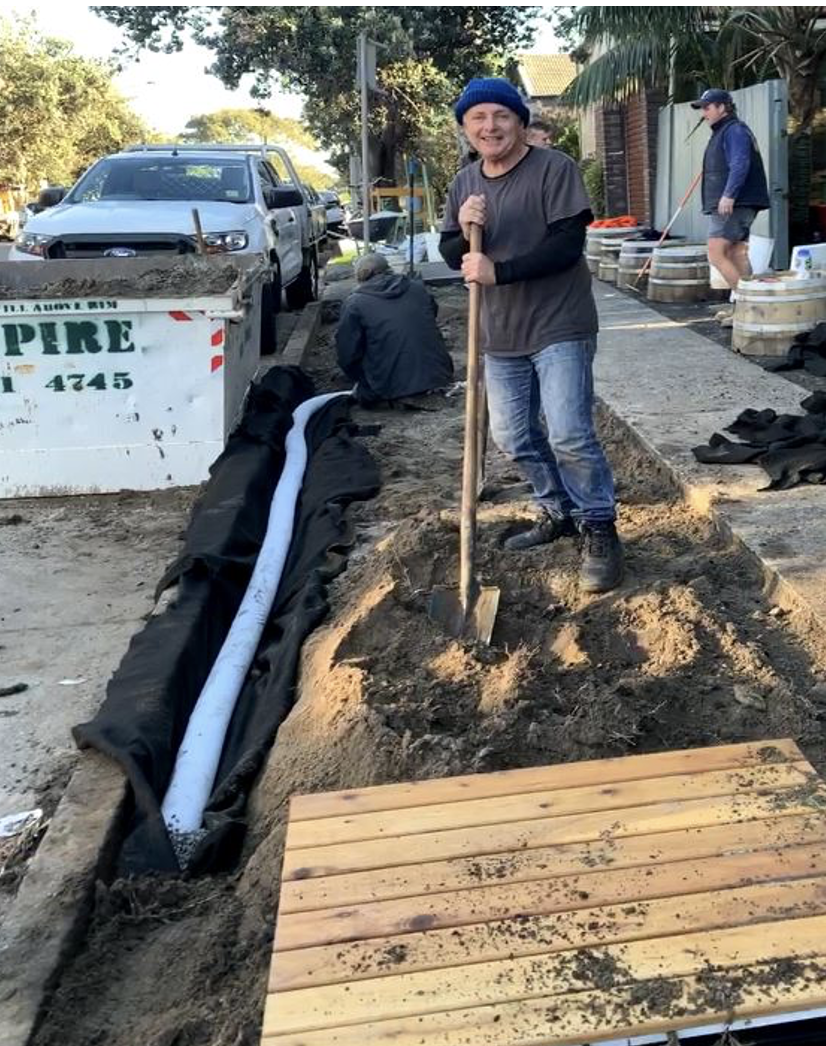
• Raingarden in the footpath outside the Shop and Wine Bar, Bondi Beach, built 2019
Cost: one days labour for two people, fruit trees donated by local gardener, agricultural drainage pipe ~ $120
This raingarden above catches and absorbs rain from the roof of an adjoining block of flats and supplies water to fruit trees and plants in the verge garden
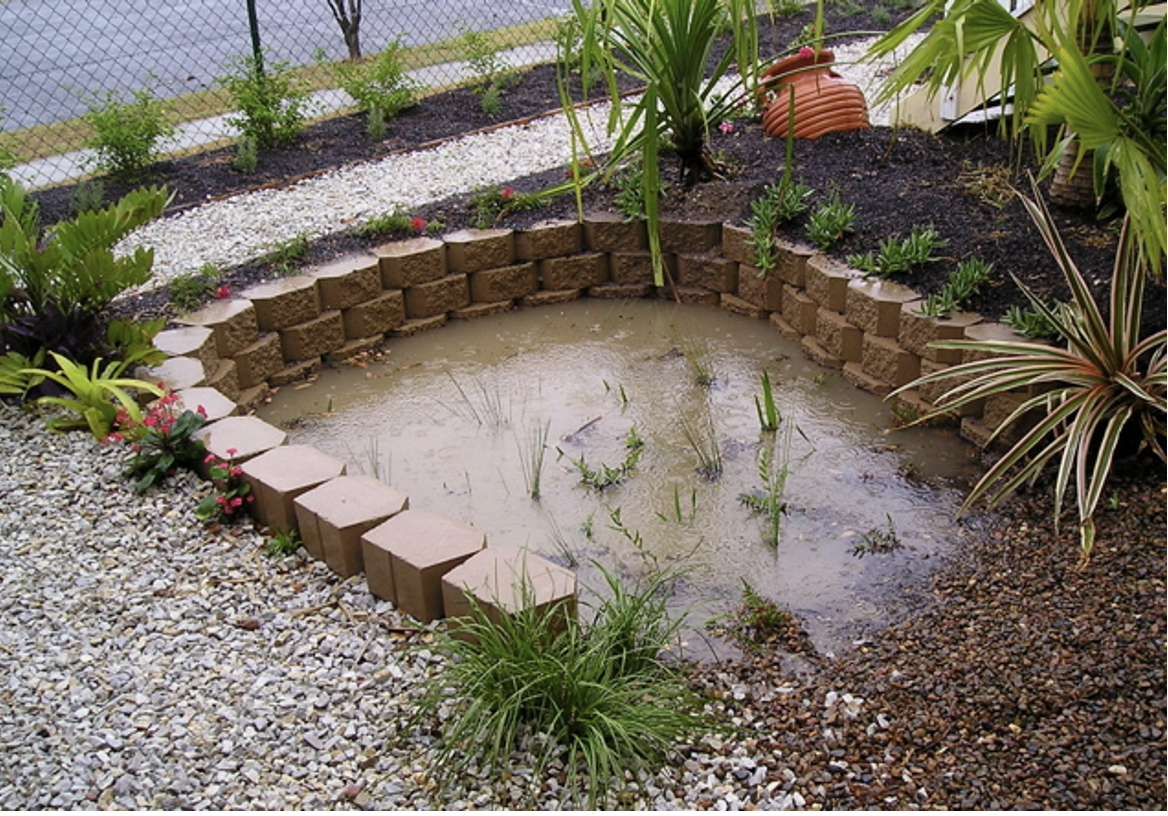
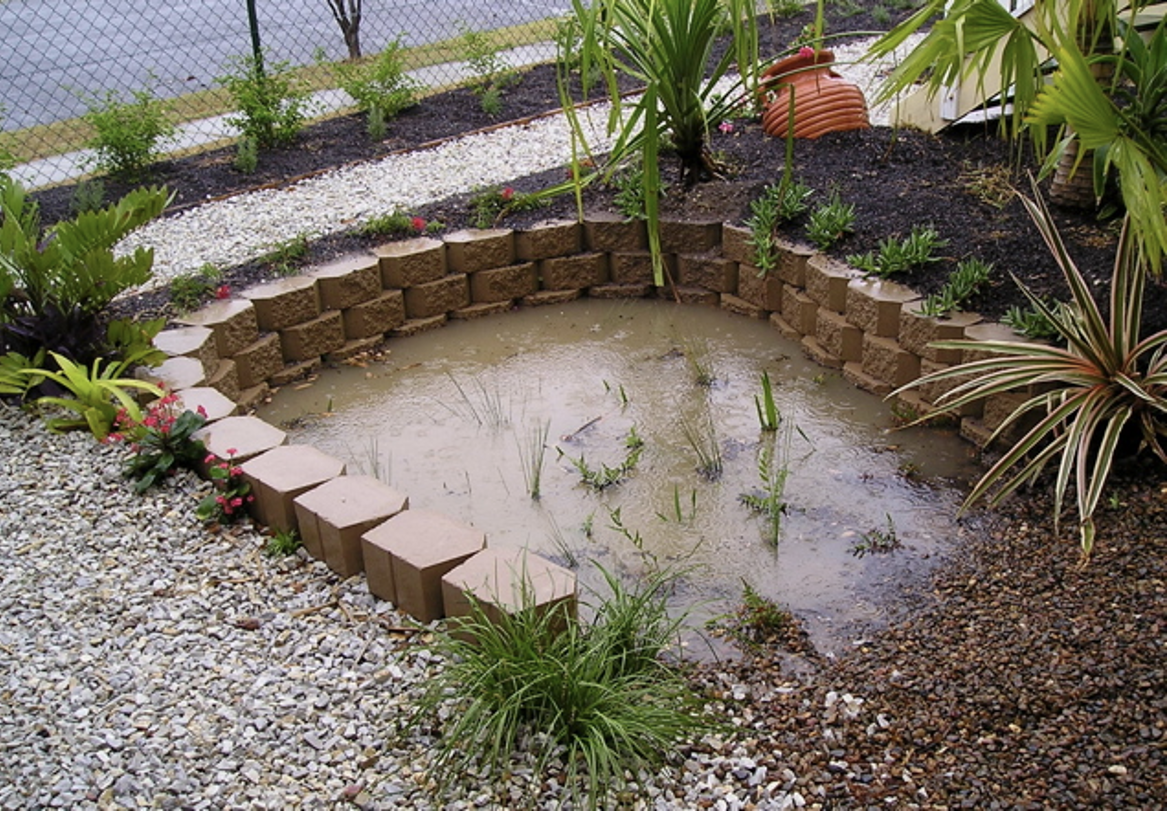
• Raingarden by Jerry Coleby Williams, Gardening Australia presenter for the state of Queensland; cost estimated at ~ < $500
This raingarden is the last and lowest part of Jerry’s garden to catch and hold rain which overflows from the rest of the house’s gardens and other temporary water holding options.
But wait, there’s more . . .
In addition to keeping all rain on the 150 m2 site of Sydney’s Sustainable House (garden is 50m2) for the 30 years since it was made off grid in 1996 the house does not import town water and keeps all sewage here to be recycled to flush the toilet and wash clothes.
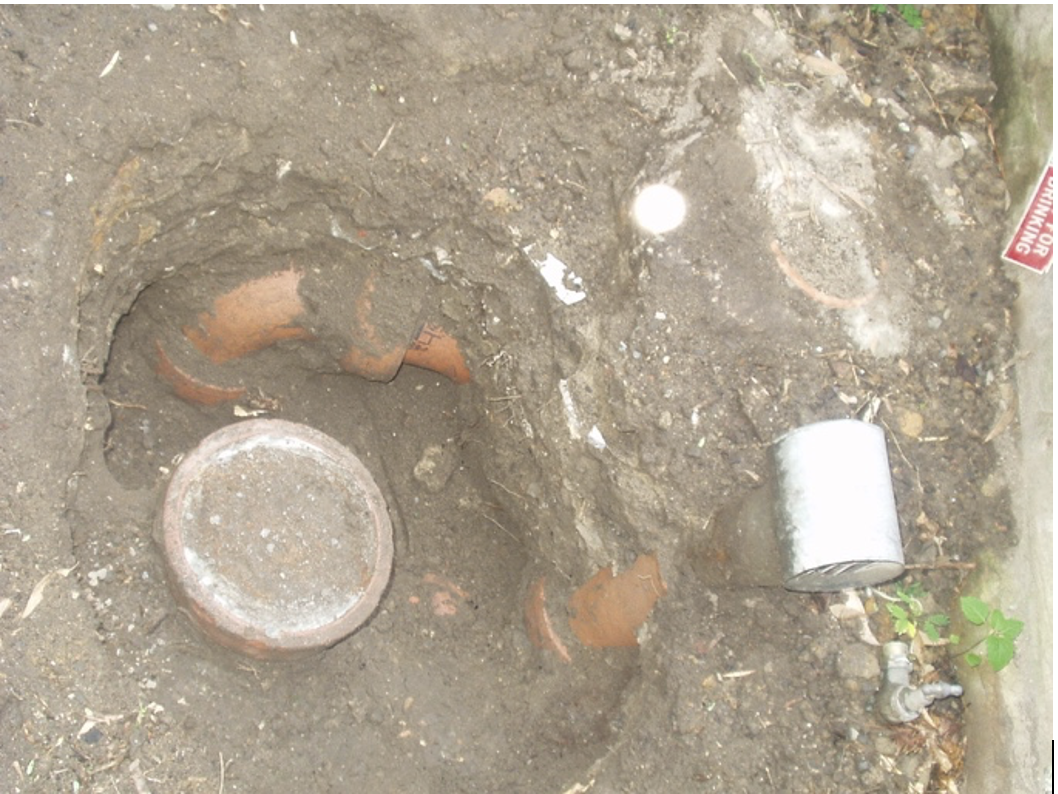
• Sewage pipe at my house blocked off with concrete by plumber supervised by Sydney Water inspector
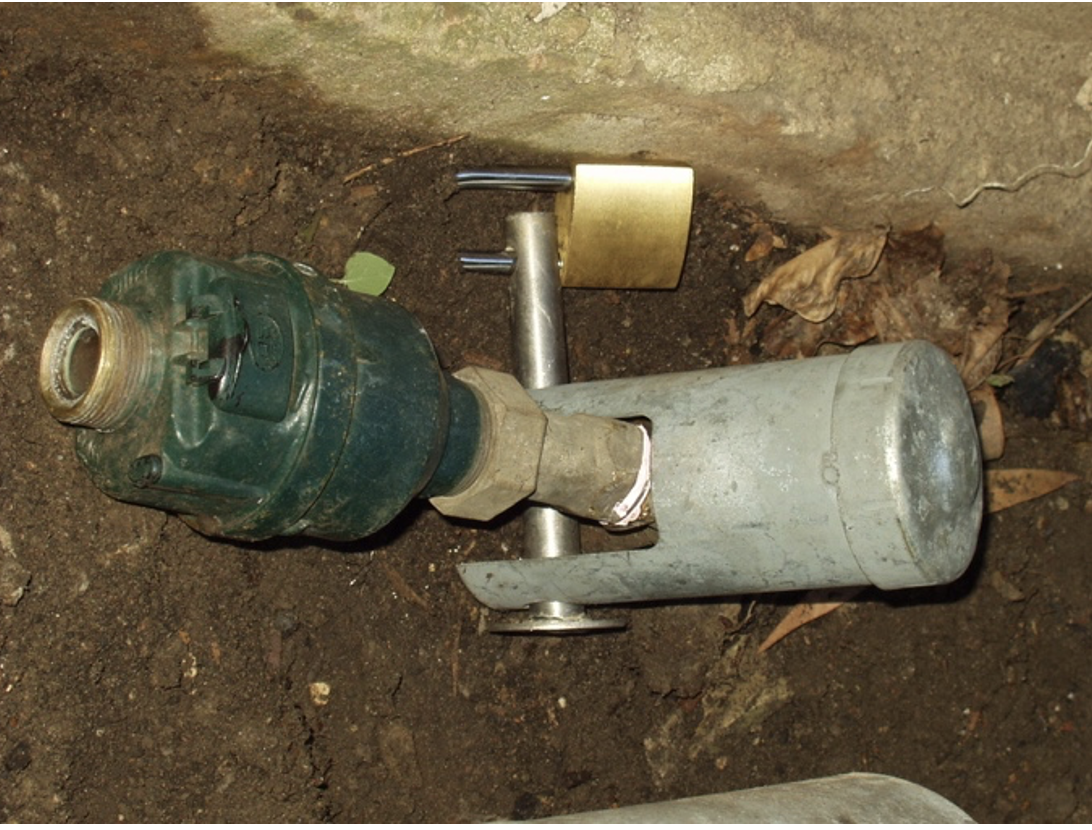
• Town water at my house locked off by Sydney Water which holds the key
Examples of ‘not a raingarden’
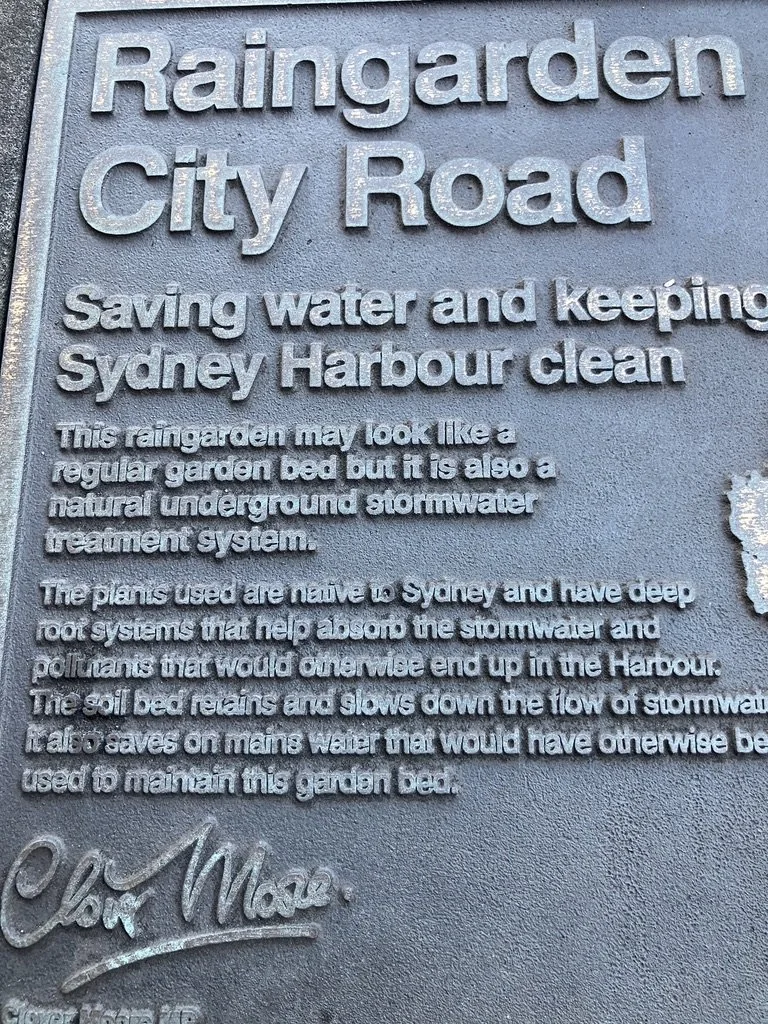
• Words on metal plaque claiming this Chippendale installation is a raingarden - untrue, unfortunately
The words below, copied from the metal plaque above, are 100% untrue; there are none of these:
· “underground stormwater treatment system”; no, only solid rocks and stones
· “plants with deep root systems that absorb the stormwater and pollutants that would otherwise end up in the harbour”: no, all the plants died, the pollutants still flow
· “soil bed retains and slows down the flow of stormwater”; no, there is no soil bed, just solid rocks and stones
All the plants in the photos below of the City Road ‘raingarden’, taken in 2026, were later planted in the soil located above the stone and rock base and water storage area by residents at their own cost.
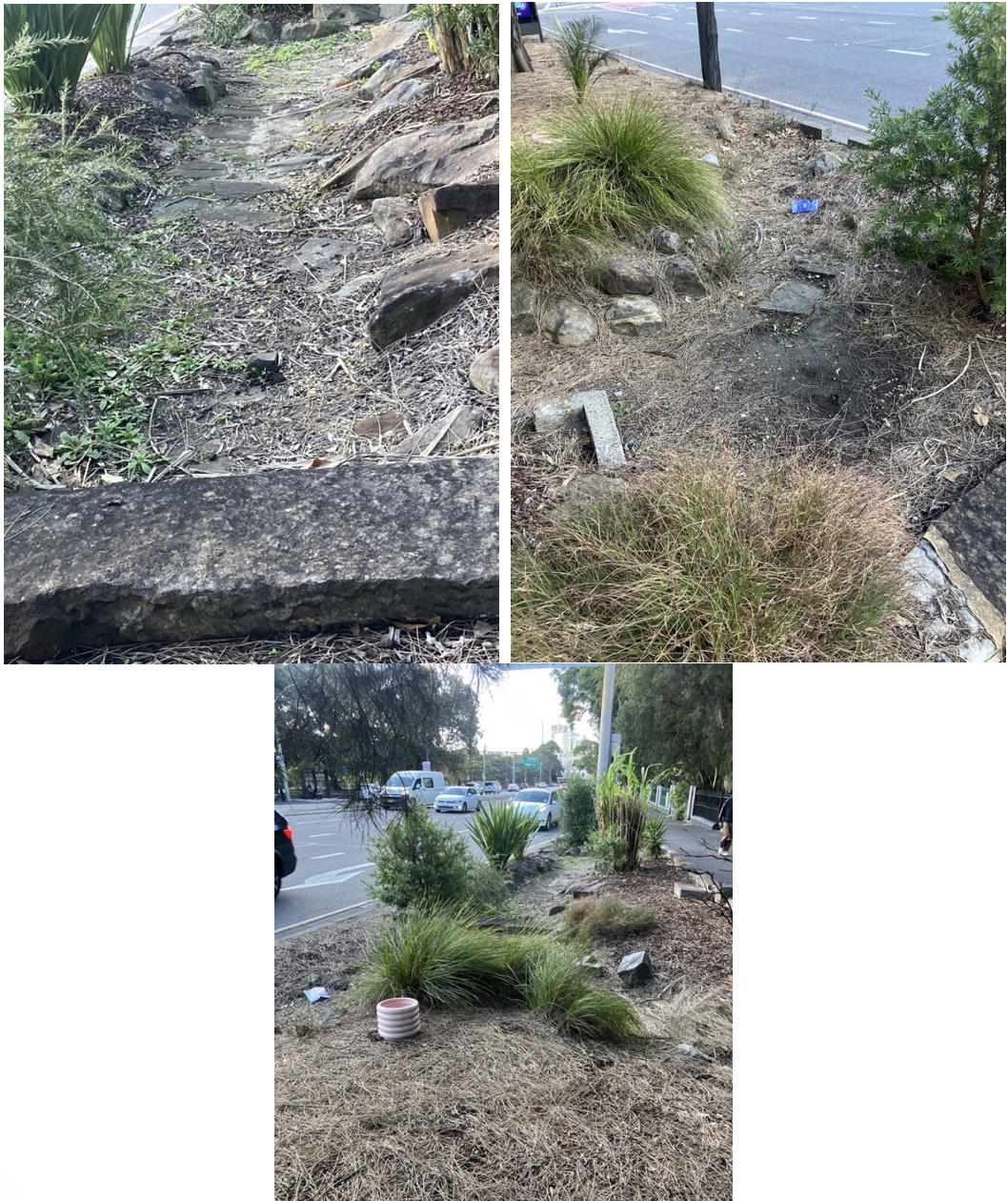
• Only rocks and stones in the base of the garden; soil is steeped up beside the rocks and stones. No opportunity for rain to soak into soil except the soil around the edges of the installation.
All 27 raingardens in Chippendale – 100% of those built - are not ‘raingardens’ and have failed to keep rain where it falls because:
· They’re mostly made of steel, concrete, timber and plastic
· No soil or plants to absorb rain in the water storage area
· Only plastic, rock, stone and concrete in the water storage area
· No water-loving plants in the water storage area and in the soil above it
· No biodiverse plants for bees and insects
The raingardens in Chippendale don’t grow plants or trees, don’t cool the streets, don’t keep water, just add to climate collapse because of the timber, steel and concrete used and the water lost to pollute Sydney Harbour and the ocean.
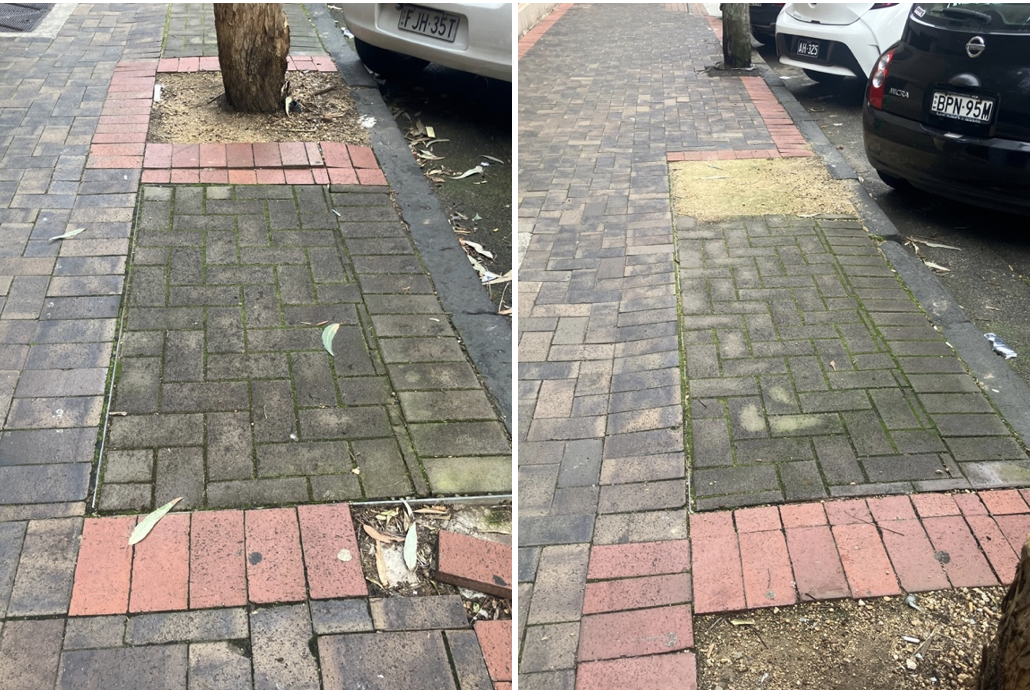
• Bricked in, failed raingardens in Chippendale
The Chippendale ‘raingardens’ don’t cool the streets or grow trees
Temperatures in Chippendale were monitored 24/7 in a two year project carried out by Sustainable Projects and substantial data is on the project website – Street Coolers.
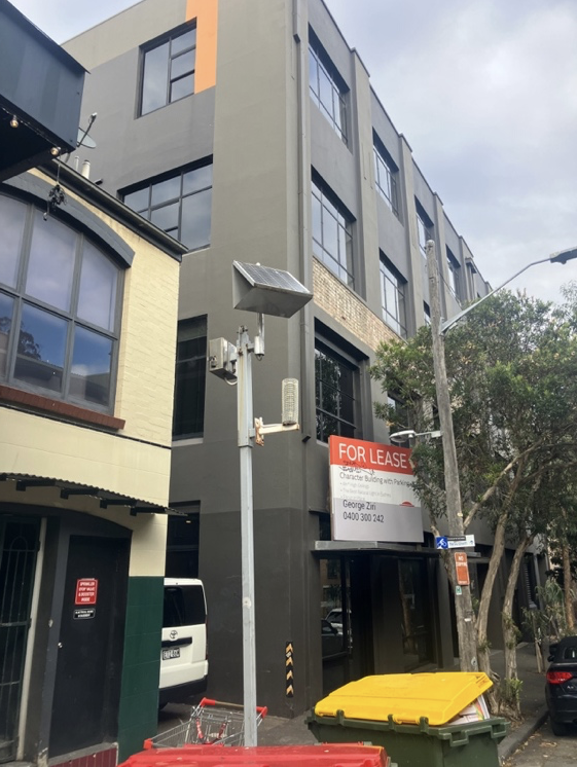
• Solar powered temperature monitor on pole outside The Chippo Hotel in Myrtle Street, Chippendale, erected during the Street Coolers trial by Michael Mobbs and Sydney City Council in a collaborative research project; the project reports are on the website; photo taken 27 July 2026 – more details on options to cool cities below
How we can use raingardens to cool towns and cities anywhere
Raingardens can be included in local council works so as to avoid steel, concrete and timber and, in turn, to cut civil works budgets and operating costs. They also work on private land to cool houses and buildings.
As shown above, and in my book, Sustainable House, there’s a valuable, cheap raingarden in my back yard. “Valuable” because of financial savings; it simply stops water and sewage leaving my house and saves me fixed charges for town water and sewage, and ‘valuable’ because it keeps my pollution out of the suburb where I live in, Chippendale, Sydney, Australia, and out of the water which fish and other marine life depend on in Sydney Harbour.
Why a raingarden?
Raingardens:
· Cool streets, suburbs, cities;
· Grow plants, trees, insect and bee lives;
· Reduce pollution of rivers and oceans;
· Grow fish and other marine life;
· Done simply and well, are cheap to build and maintain;
· Diminish the risk or impact of fire
Are beautiful.
But raingardens which are not raingardens give none of those benefits or very little.
Examples of overseas raingarden projects and designers include:
· In Tucson, Arizona, United States - Brad Lancaster - https://www.harvestingrainwater.com/ and for his raingardens. And his book Rainwater Harvesting for Drylands and Beyond
· Also in the US, Andrew Millison – look at this Youtube video, Desert Streetside Rainwater Abundance at 25 Years.
How to understand the value of raingardens
Earth lifts up billions of tonnes of water using only her clean energy system. No oil, coal, gas is used to make rain. Look at how rich for rainwater Chippendale is.
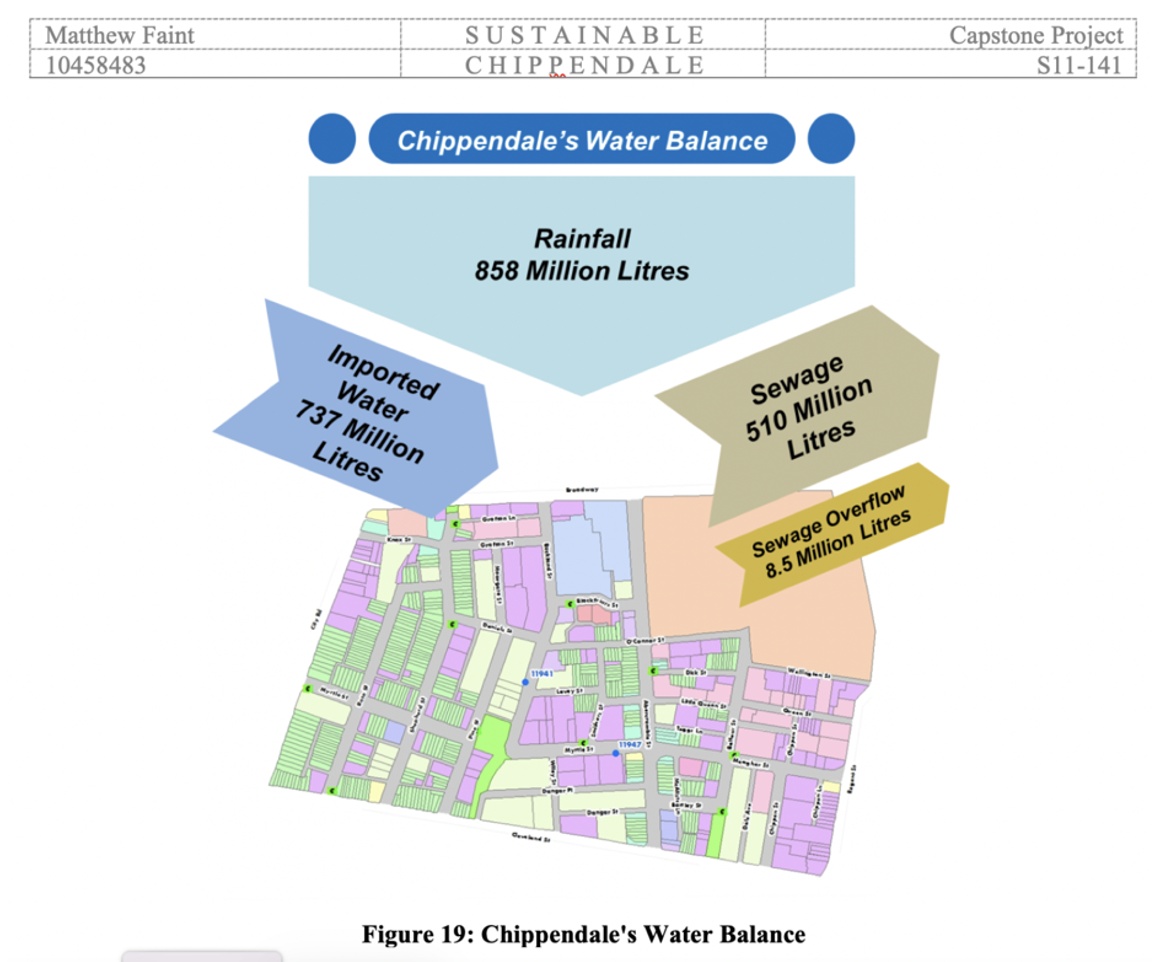
• More water falls as rain and is wasted than is imported as town water in Chippendale
Before we white colonisers came to the eastern seaboard of Australia about 80% of rain stayed where it fell and in big storms about 20% ran off to the harbour and ocean.
After we cut down almost all the trees and plants to build roads and buildings for Sydney and other towns and cities we reversed that.
Now, 80% of rain goes into Sydney harbour, Port Botany and the creeks, rivers and Pacific Ocean.
Only about 20% stays where it falls. In new subdivisions in western Sydney where there are fewer trees and more roofs and concrete, even less water stays. Temperatures are rising fastest there.
Chippendale where I live is a small suburb of about 10,000 people in about 37 city blocks beside the central business district of Sydney. It’s about 40 minutes walk from the Sydney Opera House on Sydney Harbour.
Here we can and do build raingardens on small terrace house lots and we have some citizen-built raingardens on streets so we can easily build them across Sydney and Australian cities on larger house sites and streets. But Australia’s local councils don’t.
So those cities and towns without rain gardens are hotter than they would be if they had simple, low cost raingardens. Any trees in house lots or streets have less water because less rain is kept where it falls so, in turn, the trees either die, grow poorly or do not reach their natural height or canopy sizes.
Solutions to cool cities; trees and rain gardens are the most effective and raingardens are quicker to build and harvest rain
• This trial to cool 80 m of black tarred road with a thin coating of pale cement was conducted by Street Coolers and Sydney City Council. The temperature gauge to measure temperatures during the trial remains in place outside the Chippo Hotel at the intersection of Abercrombie and Myrtle Streets; see photo above.
Data from the project shows that to cool a street it’s far cheaper and quicker to build raingardens and to grow trees with tree and plant growth increased by water retained by raingardens.
For data on options to cool cities there’s data on temperatures on this website, Street Coolers, gathered from two years of trials in Chippendale and Newtown.
Engineers don’t talk to citizens
When we compare the engineering design of raingardens with the huge engineering project of the Murray Darling River system we see the same error; engineers confident they know best and the community doesn’t, isn’t relevant.
The engineers who ran the original River Murray Commission from 1917 to the 1960s, designed and built 35 locks and weirs, a Lake Victoria Storage and an upper Murray Storage, and the Hume Dam.
“The RMC oversaw massive water infrastructure building across the Basin over the next five decades . . . During these times, the RMC operated like a small, exclusive ‘club’. Its four members were the three peak level water-related engineers in each state, the ‘Engineers-in-Chief’, plus the President, who was a senior Commonwealth member. . . At that time, no role was seen for wider consultation with stakeholders. . . Discussion with water users was a matter for individual States. As most water users were within the state-owned irrigation areas/that held the overall water allocations, this seemed a bit like “consulting with oneself’. . . large government technical/engineering departments tended not to regard consultation with water users as important . . . That changed during droughts of the late 1960s when salinity and deteriorating water quality became a major issue.” pp31 to 34. Caught in the current, the dire consequences of politics driving the Murray-Darling Basin Plan by Patrick J Byrne https://www.wilkinsonpublishing.com.au/product/caught-in-the-current/
As a student in the 1960s at Yanco Agricultural High School located beside the Murrumbidgee river (part of the Murray Darling river basin) and in the NSW Riverina area near the town of Leeton, I saw the failure of water engineering across the countryside there.
The orchards and farms irrigated by water diverted to them from the Snowy River Hydroelectric Scheme were dead and dying. The irrigation water had lifted the salt from below the soil and killed the trees and paddocks.
The fragility of most engineers and councillors makes our towns and cities fragile
Our cities are designed and built by planners and engineers. The drawings by engineers for roads, footpath, raingardens are never published before a project begins or afterwards.
Yet designs for most private sector projects are automatically published and available to the community on local Council websites so the community may comment on the proposed design and project.
It is rare for a local Councillor in Australia to have engineering experience or qualifications. The last six Presidents of China have all been qualified engineers which partly explains why China now makes most of the world’s products.
Council engineers may typically present to Councillors quarterly reports of the civil works of designs they have done or are planning.
But Councillors and Council engineers never seek to involve those who elect Councillors and who pay for the engineering work – the community. The only way citizens in Australia may get copies of local council engineering drawings is by submitting a freedom of information request. But, with the drawings and construction contracts already made, there’s no opportunity to revise the drawings or reduce the costs – paid by the citizens in their rates.
Australian cities and towns are not fit for purpose. They’re too hot, too dry, too water-hungry, too energy-hungry, too vulnerable to centralised food, water, energy and transport systems. Engineers have the biggest budget and are the people who have most power about what the streets of our towns and cities do or do not do with rain. Plans are made in secret, kept in secret and hard to get.
Design dominance by Council engineers, hidden behind a systemic wall of secrecy, is driving up city temperatures where they needn’t. The lives being lost to avoidable high temperatures because of treeless, water less roads has been measured and predictions made for increases in mortality for each Australian city.
The Australian National Climate Risk Assessment published in September 2025 predicts Sydney will have a 444% increased mortality from increasing heat in the next 20 years. My guess is most engineers and Councillors in Australia have not read and have little interest in that Assessment.
Generally, there’s complete control and too little accountability from Australian city makers and particularly from engineers.
City-makers confuse having control with getting a good result, comforted and untroubled by the lack of scrutiny by the public and the lack of construction experience in local councillors.
The irrelevance of Engineers Australia’s Code of Ethics
The Code includes these ethics recommended for engineers:
“1 Demonstrate integrity
1.1 Act on the basis of a well-informed conscience
1.2 Be honest and trustworthy
1.3 Respect the dignity of all persons
2 Practise competently
2.1 Maintain and develop knowledge and skills
2.2 Represent areas of competence objectively
2.3 Act on the basis of adequate knowledge.
. . .
4 Promote sustainability
4.1 Engage responsibly with the community and other stakeholders
4.2 Practise engineering to foster the health, safety and wellbeing of the community and the environment
4.3 Balance the needs of the present with the needs of future generations.”
Where would our streets and cities be without that Code? Probably in the same waterless, over-heated state they are now.
The future is here, and everywhere
The future is now the present everywhere on Earth.
In Canada, France and Spain over 300,000 people this last month of July 2026 have had to flee their homes from out of control fires. Those fires are coming to Australia this summer of 2026. Get ready for headlines like these but with Australian place names:
- Thousands flee wildfires in France and Spain https://www.theguardian.com/world/2026/jul/23/people-evacuated-intense-wildfire-saumos-france
- Over 300,000 people forced out of their homes in France and Spain:
- Fires in Canada spew smoke over the US and 55 million Americans under air quality alerts
Rain
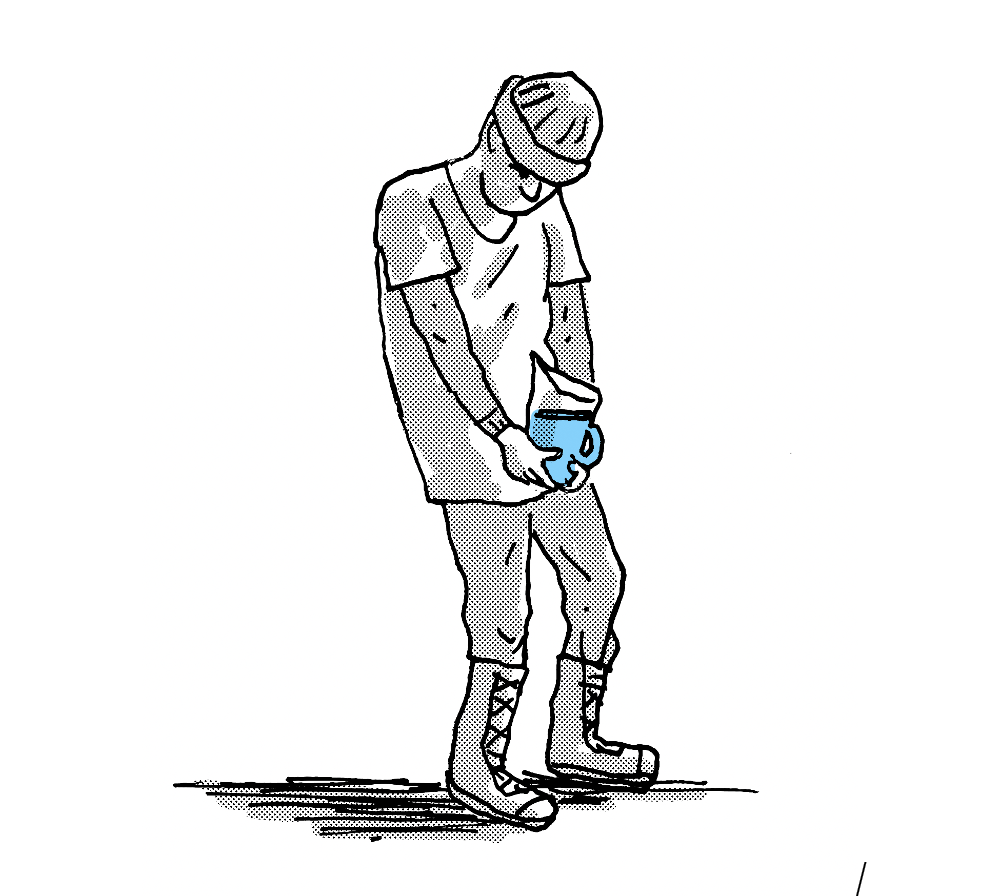
By Fionn McCabe, 2025
Time listening to rain on my roof brings me timelessness. Rain spells me. The sound, the feel of it frees me, contains me, held fully by my amygdala.
By
Michael Mobbs, July 2026