
Cautionary tale on minor inconveniences
By
Emilio Hugler, intern with Sustainable House
When a minor inconvenience meets a larger problem, oftentimes we think about it and say: “Well, I got more important things to worry about”.
Now, I think about those times when that minor inconvenience turned from a small snowball to a large one, when I kept rolling and going. And it’s not fair to say we should worry about everything, but it is fair and constructive to open our eyes to these smaller inconveniences that may lead to something bigger and keep ourselves accountable.
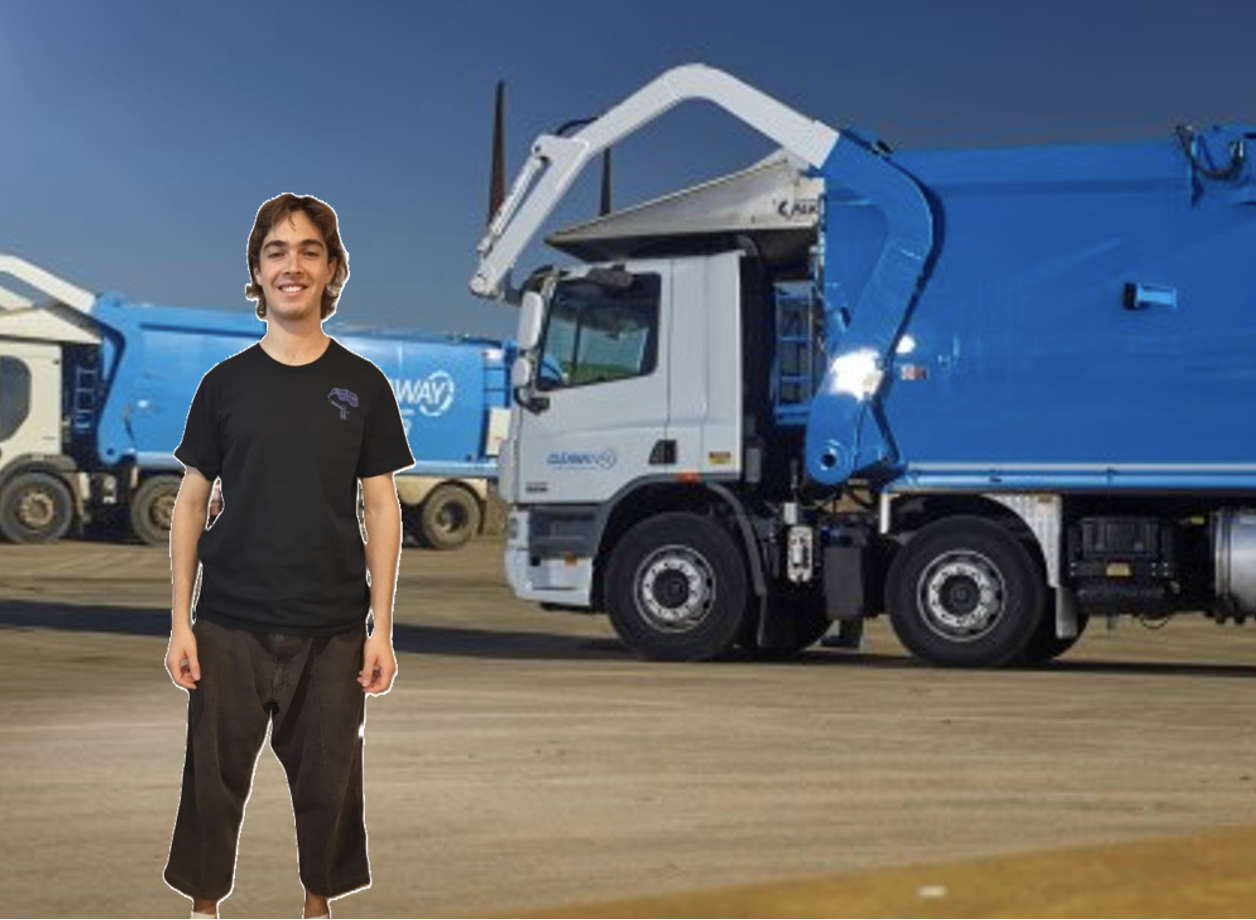
• Me, Emilio Hugler, with a big time transport polluter
I shall present myself; my name is Emilio Hugler. I come from Mexico, I’m currently enjoying the Aussie life while on exchange, and Michael Mobbs has let me intern with him.
When Michael tasked me to estimate transport emissions from food waste, I came across a NSW Environment Protection Authority fact sheet [1] about transport emissions. They talked about this minor inconvenience—referring to transport emissions in the whole lifecycle emissions of food waste — and how changes in transport would have only a ‘minor’ effect.
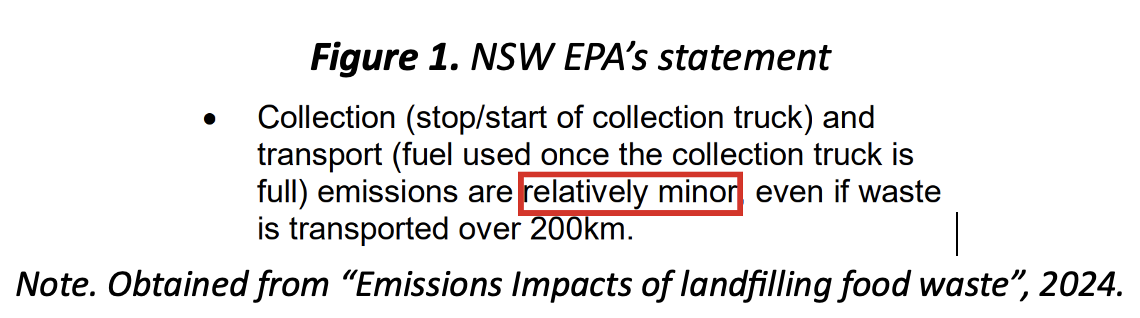
It got me thinking. “How minor are we talking about, and hell, maybe I shouldn’t waste my time analysing them”. Oh, how wrong was I to think that.
Still, I broke down NSW EPA’s statement and got into the details. I discovered their words came from the work this consulting company called Blue Environment Pty Ltd did for them back in 2023 [2]. Blue Environment, I supposed, was tasked to quantify the lifecycle emissions of food waste when it is disposed of in many different ways, such as the famous “Business as Usual” and “FOGO”, so NSW Councils could make informed decisions regarding their food waste disposal—good stuff by NSW. Unfortunately, the more I looked into it, the more I looked into transport emissions, the minor inconvenience rolled and rolled to something that couldn’t be ignored any more.
I want you to look at this graph below that I made based on Blue Environment’s work and their assumptions.
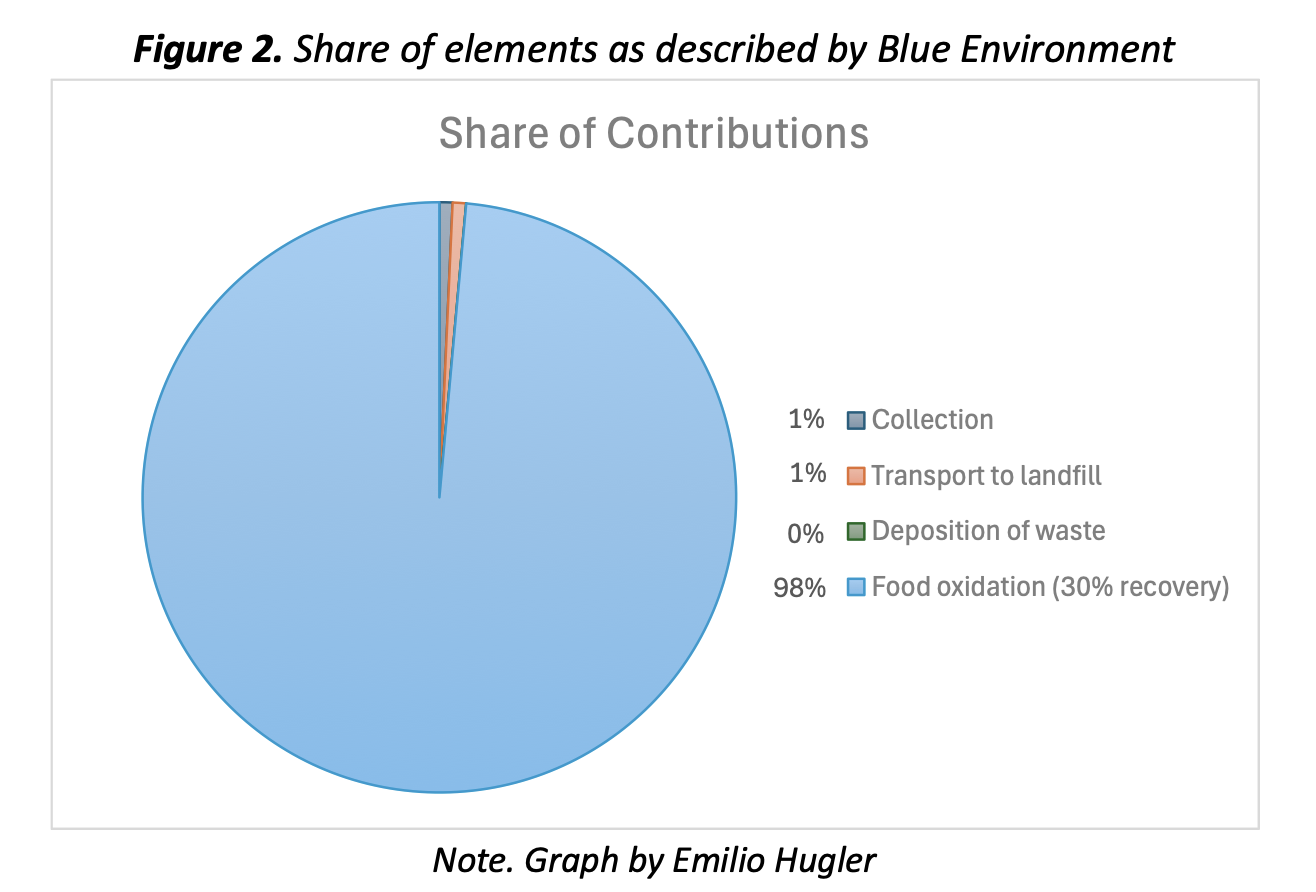
The graph shows our minor inconvenience; transport emissions which come from collection and transport of food waste to a landfill. Being objective; it really is minor, it’s merely a 2% of the whole problem, small enough to go unnoticed, but still I tried to remain aware and constructive.
So, I looked and looked into the details, Blue Environment’s assumptions, maybe they forgot something, or didn’t include this or that, and there I found it, what was missing, Blue Environment didn’t include the full lifecycle emissions of garbage trucks! They completely overlooked how polluting it is to make a garbage truck and keep it running. Look at the table below, Figure 3. Life cycle GHG emissions of garbage trucks
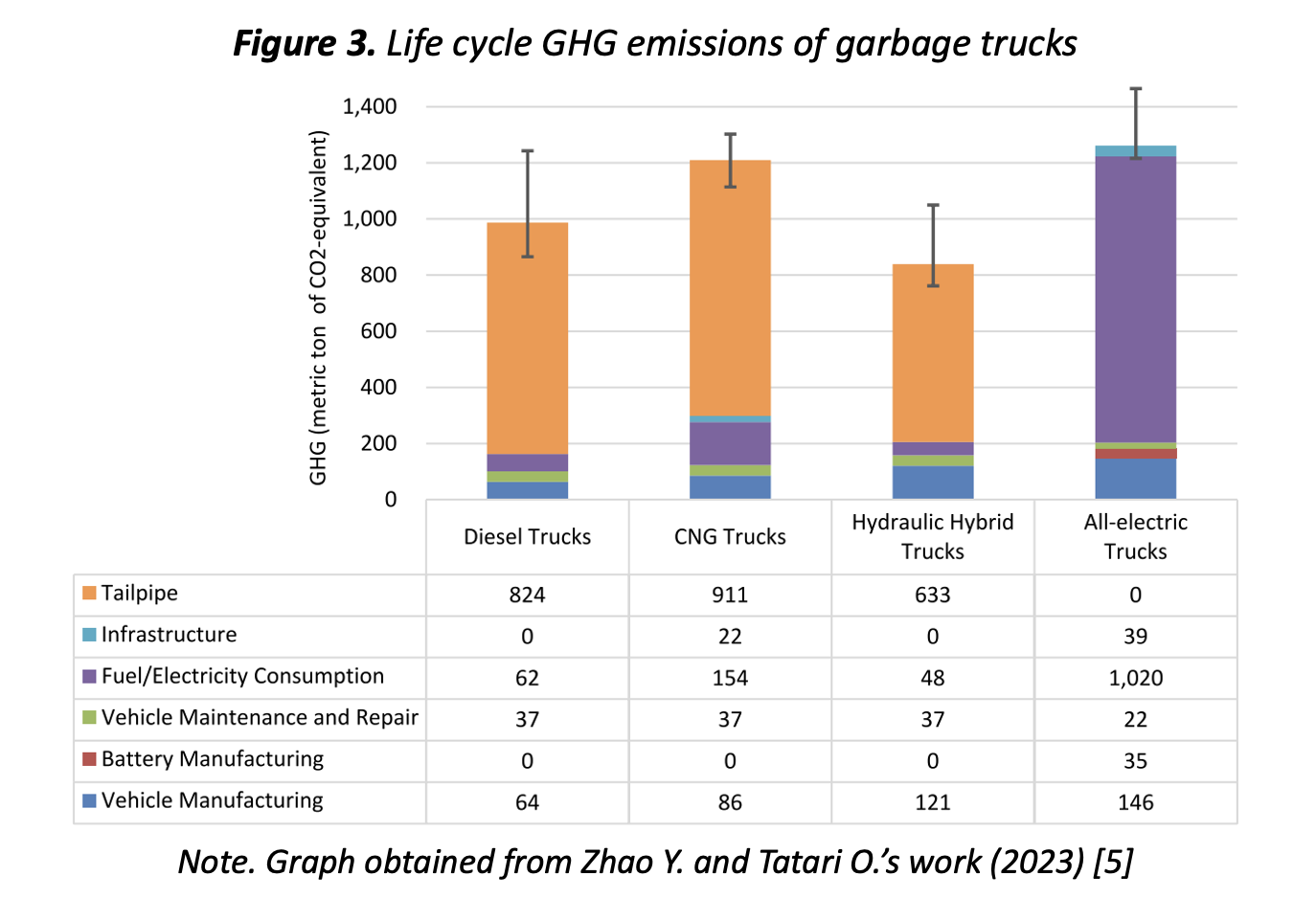
The table above shows the full lifecycle emissions of a garbage truck.
Now, for Blue Environment transport emissions come only in the form of tailpipe emissions, ignoring other components like infrastructure, fuel consumption, maintenance, and manufacture. Look at the pie chart below so you get a sense of what was missing.
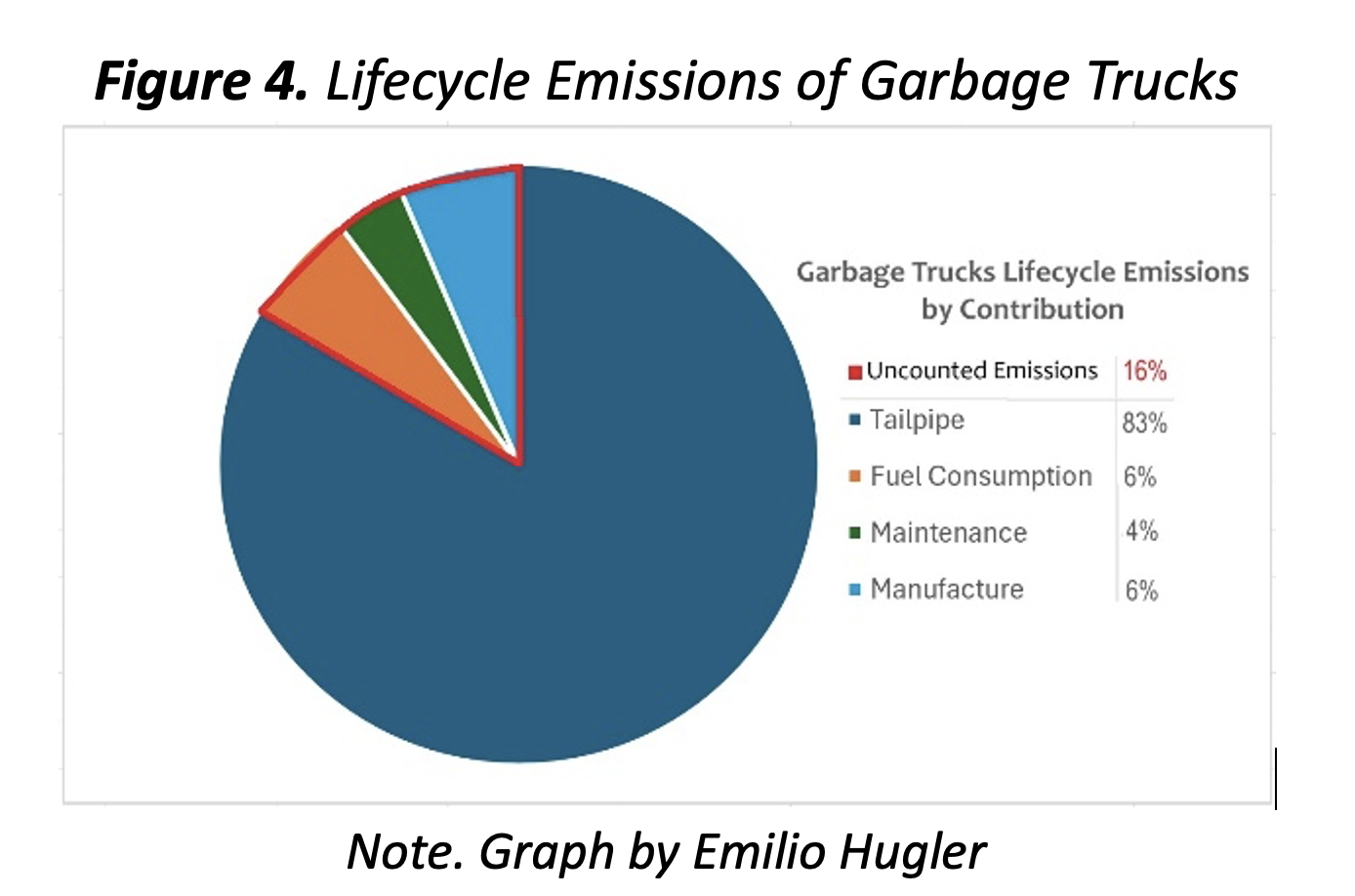
The small inconvenience started to roll; it was now rolling into a bigger problem. Once I noticed these missed contributions to the total emissions, I saw how transport in FOGO was being underestimated.
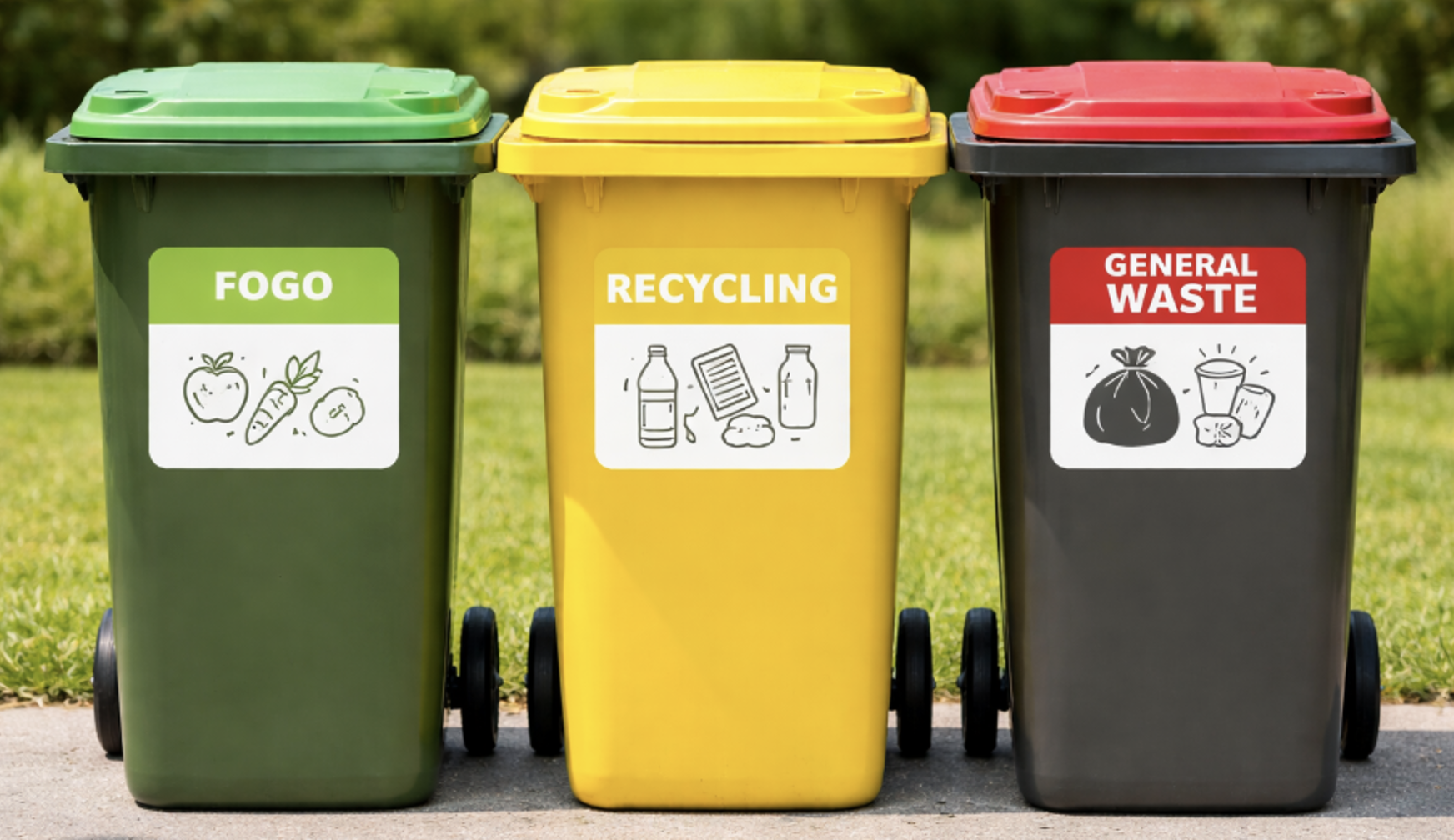
You see, the thing with FOGO is that it essentially adds another waste stream, especially when we put our food waste - FOGO - in a third bin. Even when food waste is composted and we - and Earth’s air which gives we humans and all else life - get some or all the benefits of compost, adding another stream of waste is too taxing because of the transport emissions. When anyone - for FOGO that’s a local council and a state government - add another bin that adds more trucks, and more truck trips.
We also have to add the trip to the treatment facility far away from the city where FOGO may be composted and the trip back to the city that brings the resulting soil to farms, or in some places to the garbage truck owner. Garbage truck busineses are adding to their income stream by selling compost they make from FOGO food waste. But local council rates don’t get reduced.
That’s how FOGO works.
Finally, when you add up all of the missing pieces you get the following results.
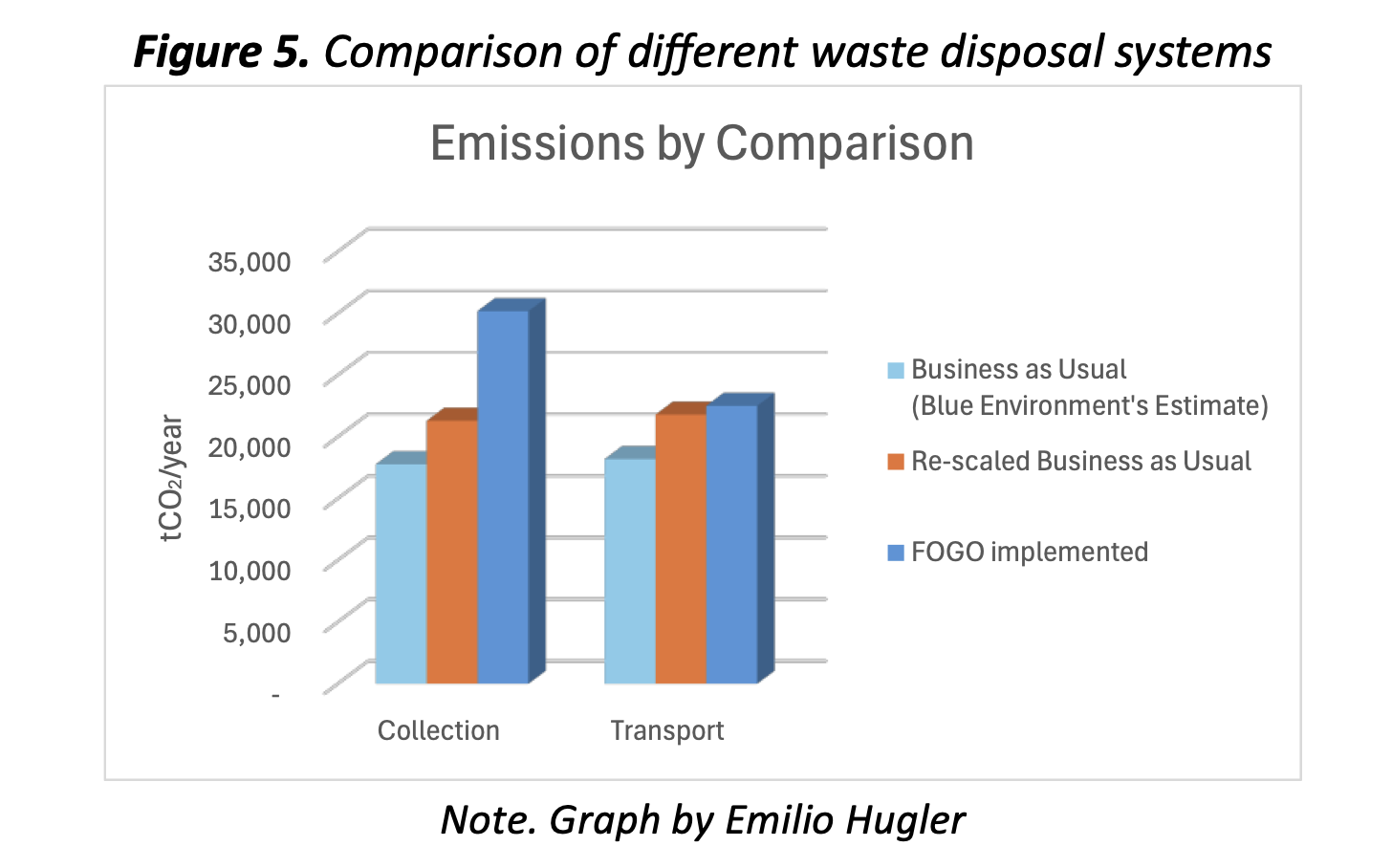
There were certain things Blue Environment didn’t see or showed. My estimates show that a considerable number of emissions were ignored, and it’s unclear to me whether NSW and other state Councils are aware of these limitations or not.
Transport emissions are still a small part of food waste lifecyle emissions, given the scale of emissions that come from food waste decomposition, but still, emissions hurt our planet, and no number of emissions should be considered minor.
I’ve written about my research in the hope I may increase awareness; it shows that minor inconveniences sometimes tell big stories, not always, but sometimes, and I should always remain curious and accountable.
The solution?
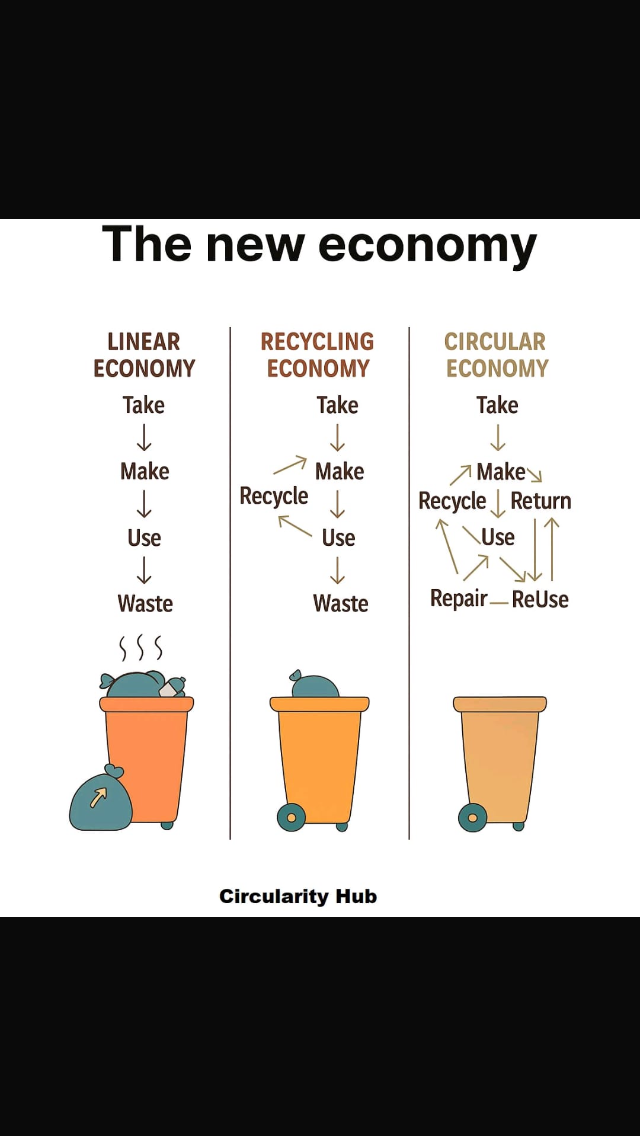
Some of the research I’ve referred to here is also in the project report by Michael Mobbs for Melbourne City Council, Your Seat of Power - the Smart Worm Bench Project, a project by Melbourne City Council called, Worms at Work, and described on the Council’s website.
That is a circular economy or net zero project that is different to the linear economy of FOGO and garbage systems in Australia; the difference between these economies is shown in the image below.
If you want to read more technical, academic, and detailed reports on how I got my numbers you can check it out in the links below.
Until next time!
§ References
[1] NSW EPA. (2024). Emissions Impacts of landfilling food waste. Retrieved December 10, 2025, from https://www.epa.nsw.gov.au/sites/default/files/24p4522-emissions-impacts-from-landfilling-food-waste.pdf
[2] Blue Environment. (2023). Organics Processing Technology assessment. Retrieved December 10, 2025, from https://www.epa.nsw.gov.au/sites/default/files/organics-processing-technology-emissions-2023.pdf
[3] Global warming potential | Clean Energy Regulator. (2024). https://cer.gov.au/schemes/national-greenhouse-and-energy-reporting-scheme/about-emissions-and-energy-data/global-warming-potential
[4] Department of Climate Change, Energy, the Environment and Water. (2025). Reducing Australia’s food waste. In Australian Government. Retrieved December 10, 2025, from https://www.dcceew.gov.au/environment/protection/waste/food-waste#national-food-waste-strategy
[5] Zhao Y. Tatari O. (2017). Carbon and Energy footprints of refuse collection Trucks: A Hybrid Life cycle evaluation. Sustainable Production and Consumption. https://www.sciencedirect.com/science/article/pii/S235255091730026X
[6] Carroll, G., & Miles, D. (2024, May 1). Electric garbage truck trialed in Shepparton as driver lauds its quiet “luxury.” ABC News. https://www.abc.net.au/news/2024-05-01/electric-vehicle-garbage-truck-trial-shepparton/103780418